Welcome to the Colour and Ceramics Podcast.
Bob Acton @bobacton had a great conversation with Adrian Arleo about her sculpture work and her use of colour and surface design.
Check out Adrian's website here https://www.adrianarleo.com/ and her Instagram page here https://www.instagram.com/adrianarleo/
[00:00:00] My thing, when I open my kiln after a glaze firing, I tell myself, don't worry, this is just the beginning, you know, and that I use wax and caustic on my work.
[00:00:17] I use casein paint, I use the gold leaf, sometimes gold luster, washes of different kinds of paints. So that last glaze firing is not the end.
[00:00:34] Hi, I'm Bob Acton and I'm pleased to share my conversation with the great Adrian Arlio. Adrian studied art and anthropology at Fitzer College and received her MFA in ceramics from Rhode Island School of Design in the US.
[00:00:50] Adrian has spent the last 28 years living outside Missoula, Montana with her family and a menagerie of animals. She works full time as a ceramic sculptor.
[00:01:02] And her work is exhibited internationally and is in numerous public and private collections. She said, for 40 years my sculpture has combined human, animal and natural imagery to create a kind of emotional and poetic power.
[00:01:20] Often there's a suggestion of a vital interconnection between the human and non-human realms. This imagery arises from associations, concerns and obsessions that are at once intimate and universal.
[00:01:35] Her work frequently references mythology and archetypes in addressing our shared vulnerability and changing personal, environmental and political realities.
[00:01:47] I hope you enjoy our conversation. You can find out where to connect with Adrian in the show notes and you can find all that information at ColorInSaramix.com.
[00:02:00] Welcome to Color In Ceramics, the podcast for ceramic artists who want valuable ideas about using color from leading artists and world-class experts.
[00:02:10] Here's your host, Bob Ackden, a sculptor and ceramic artist who's fascinated with color and how potters, sculptors and artists use color in their work.
[00:02:20] Tune in as he talks with his guests about color, techniques and the impact of color on people and art itself.
[00:02:27] Adrian, welcome to the Color In Ceramics podcast to talk about color and surface decoration. I'm really excited about having you here today.
[00:02:37] And I love your beautiful ceramic sculptures and their intricate surface designs. Those are just exquisite.
[00:02:46] And you know, I'm really intrigued with your approach to color, which seems subtle and where your attention is really focused on the form and the surface itself.
[00:02:59] And recently I've noticed that you started using some touches of gold on things.
[00:03:04] Thank you. My pleasure.
[00:03:07] You know, the creativity I see and feel when I look at your work really represents probably years of hard work.
[00:03:15] Can you tell us a little bit about your journey to becoming the artist you are today?
[00:03:22] Yeah, I became interested in ceramics.
[00:03:26] When I was kind of an adolescent, I would say. I remember as a kid, my brother was taking a pottery class and so there was, you know, some clay around.
[00:03:39] And I remember like going to pick him up and fooling around with clay, like in a big slurry bucket and just feeling really excited about kind of the, well, kind of a narrative that could just be created through my hands.
[00:04:03] And I was like making objects that for me could carry like an emotional power. That's what really hooked me just in creating in general, I would say.
[00:04:18] And then with ceramics, there's the whole process of, you know, making this thing and then firing and then the whole glazing.
[00:04:29] And especially in the beginning, not really having a sense of what was going to happen, how it would look coming out of the kiln.
[00:04:37] So, you know, everybody talks about it being like Christmas, you know, when you open the kiln and there it is.
[00:04:43] Sometimes you get what you want and sometimes you don't.
[00:04:47] But, you know, with low fire commercial glazes in the beginning everything is bright and shiny and that was fun, you know, when I was young.
[00:04:58] And when I went to college, I got more interested in muted surfaces. I was using low fire glazes and kind of washes not glazes under glazes and washes and wanted a well a more naturalistic surface that seemed appropriate for sculpture the shiny glazes to me.
[00:05:25] I pretty much always reference pottery.
[00:05:29] But on a sculptural form, I want something to look more naturalistic, unless I'm doing something that I want to reference water, you know, but then that's always in contrast with a more matted surface.
[00:05:46] I was using a lot of under glazes and then I became interested in terracotta gelata, which has a much richer surface than under glazes.
[00:05:59] I liked to layer the glazes under glazes or sorry, the terracotta.
[00:06:09] When I was in graduate school.
[00:06:11] There was a painter.
[00:06:14] And I'm blanking on his name, who did egg tempera paintings that looked like little pieces of old frescoes.
[00:06:27] They the colors were were layered and then he used super fine steel wool to send through the colors and reveal the colors underneath.
[00:06:39] And then they were kind of waxed, I think. So they were really, really rich and had this just this feeling of earthiness and history and just rich and and I thought well I bet I could get that kind of surface with
[00:06:58] terracotta and I was a little bit more like a terracotta.
[00:07:13] And it was really beautiful.
[00:07:14] It was very much.
[00:07:16] The colors would stay separate, you know, in the, in the layers of things wouldn't get smudged around the way they could with maybe under glazes.
[00:07:25] And yeah, getting into patterns on the surfaces. I was before I got into doing very specifically figurative work. I was looking at kind of the coral reef as a context or as the environment that these sculptural forms were coming out of I did these kind of sea slug things and then they became kind of anthropomorphic so there was
[00:07:54] a lot of color like muted color not super bright but muted color and pattern and just I was really interested in this very rich kind of surface on those pieces.
[00:08:12] After a while I started feeling like these were kind of more about a beautiful surface than having any real content that felt for me, I would say important.
[00:08:31] So that's when I became much more interested in working directly with the figure the human figure.
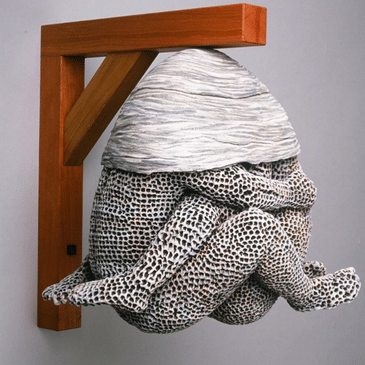
[00:08:40] And getting more into textures and the surface referencing other kinds of materials that added another layer to the content of what was happening with this figure.
[00:08:56] You know, thinking about what it would feel like or what that kind of surface suggests. You know if it's stony or watery or something that looks like it's growing or deteriorating.
[00:09:14] If it be hives, wasp nests, something that's alive like leaves or just all these different materials that suggest kind of a different way of being.
[00:09:37] Really accentuated the narrative of the piece itself.
[00:09:41] Yes, yes and I've always had an aversion to making figures that just look like in their skin you know just like normal it's too much like oh just naked figure there's not enough kind of added information that takes it into another realm, you know be a sort of dream like or
[00:10:06] fantasy or you know just someplace else is that's it's more about what is going on internally with the figure and just this figure sitting there.
[00:10:19] Yeah, your work doesn't show an exact replica of a human form or an animal form.
[00:10:27] As you said it's got this imaginative dreamy like characteristic.
[00:10:32] Yeah, yeah that's what interests me.
[00:10:35] Yeah, very cool.
[00:10:37] Yeah, that's cool. Now you know, it seems to me that there was a guy I follow called Chris Crowley and a lot of his medical colleagues, right about what keeps us young as we age.
[00:10:52] And one of their key factors aside from the usual you know eat well and get exercise of those kinds of things is really about having a reason to get out of bed in the morning and to be excited about something that helps people age.
[00:11:09] And so with creative folks like yourself, I guess we need to also get out of bed in the morning with a reason. What gets you excited these days around your clay work?
[00:11:22] Well, you know, I'm in the midst of as I said making work for this show in July and I'm in this phase where I'm putting images that feel evocative or compelling to me.
[00:11:46] I'm putting things together where I'm not exactly sure where each one is going. And so there's, I have to feel this sort of open curiosity to see like what these things feel like when I start putting these images together.
[00:12:07] Sometimes things that, that maybe don't kind of literally make sense. I mean none of my work like literally make sense. But I have to I'm at a point with this body of work where I just want to see.
[00:12:25] I just want to see what it looks like. And I mean that's always the case but sometimes I have greater clarity on exactly what it is that I'm going for that.
[00:12:39] I feel like the work is always open to interpretation but sometimes I have a clarity as to what it's about more directly.
[00:12:50] This work I'm really flying on just intuition and not overanalyzing. It's just like trusting what I feel, what feels compelling. And then as it's all coming together I think seeing it as a group is when, when like an overall kind of story can be.
[00:13:20] taken from it.
[00:13:23] But I think right now it's just the that curiosity and a little, you know pressure of the unknown and uncertainty along with the curiosity.
[00:13:39] And I think the uncertainty that's uncomfortable but it also is kind of motivating because it's you know it's like a journey. I don't know where you're going to end up.
[00:13:55] But it's interesting along the way.
[00:13:58] Like the word curiosity before you mentioned that word was really in my mind and also excitement like it sounds like that. It's an exciting process for you and strikes me different than if you were just replicating a same object over and over again.
[00:14:16] Right. Yeah.
[00:14:17] You are here really diving down into your own imagination and that's what keeps you curious.
[00:14:24] Yeah. Yeah, I like there to be a newness. I mean I feel like the work.
[00:14:33] You know it looks like my work but I have an aversion to repetition, you know, but when it comes coming through me, sorry my dog is jumping up.
[00:14:49] Coming through me the work is even when the imagery is kind of new it's still because of my hands and muscle memory. It still looks like my work but I want it to keep evolving.
[00:15:04] Yeah. Yeah.
[00:15:06] Absolutely. Absolutely. You know, I also think about us practicing and you know if I listen to top creatives who are in the music field for example or in the
[00:15:18] art field that top people will talk about how we need to continually practice our techniques and engage in things. How do you practice? I mean you're building a piece but do you have any particular things that you do that helps you practice your techniques?
[00:15:36] Well, I right now I have these three big heads in the studio that they're way larger than life size. I think they're like 17 inches tall, maybe more.
[00:15:53] And I started them because I wanted the challenge of building just a really large head and I have to do it in a way that's different than how I would build a life size or smaller head.
[00:16:07] And so that is like a kind of practice that's pushing kind of what I know. I mean I know how to do it but it's very different for me to build a big head where I'm starting at the neck and just going up, you know, neck, chin, mouth, nose, you know.
[00:16:30] Mostly I'm roughing it out and then I'm going back in and getting into the more specific details but when I'm building a life size head, I start with sort of this skull shape and then I literally hold it in my lap and I just start working on the face with a you know really big head.
[00:16:48] You can't really do it that way. So it's a challenge for me that I was just curious to try and you know, then just play around with.
[00:17:01] Yeah, for sure. I mean it sounds like what you're doing, your practice about practicing your technique is to try something new and to challenge yourself in a way.
[00:17:11] Yeah, yeah. Yeah, for sure. Yeah, very cool. Do you have any people who have inspired you over the years? Who have you found us inspired your work?
[00:17:25] Well, I mean I probably my favorite thing that's inspirational is going to like a museum like the Met in New York you know where it's just a huge smorgasbord.
[00:17:43] So much amazing work and each time I go, I'm kind of drawn to something different. But in terms of contemporary artists or ceramic artists, you know I've always loved Akiyotaka Mori's work.
[00:18:04] I just might but I'm not influenced by it, but I love it. I'm moved to buy it.
[00:18:12] An artist like Kiki Smith, I feel great affinity to or with.
[00:18:21] I don't know if there's just, there's a lot of artists out there whose work I admire. But I don't tend to go looking at other contemporary artists to enrich my work.
[00:18:39] That to me that's like no, don't do that.
[00:18:43] Don't do that because then, you know when I'm working.
[00:18:47] I see, you know, this this is feeling derivative or this reminds me of that and I don't want to do that I have a big aversion to work that feels derivative.
[00:19:05] I think there's a fair amount of work out there where you look at it and you go, oh clearly they're looking at so and so's work.
[00:19:13] Yeah, you know, and that's that's a big no no to me.
[00:19:18] Yeah, yeah for sure. She can adapt some of the ideas you might see in some of the else's but to pull ideas directly from somebody is something for the doesn't fit well for you.
[00:19:28] Yeah. So, so why don't you know we're here to talk about color and surface design and so on and we'll get into that but I, I feel like your work has a lot of form to it.
[00:19:40] As opposed to a bowl, let's say that we put some color and surface on. How do you balance the use of color with these other elements of design like form and texture in your work.
[00:19:55] Well, because so much of the imagery is drawn from nature or things that suggest natural things.
[00:20:06] The, the palette is fairly, I would say neutral, you know, Browns blues that are subtle.
[00:20:20] I like to layer the glazes so there's, there's a richness like a saturation of what's underneath coming through.
[00:20:30] So there's depth to the surface.
[00:20:36] I don't know, you know, lately, the last, I don't know a few years, I kind of am drawn to wanting to keep the color pretty minimal muted. So it is more about the form.
[00:20:54] But then there's sort of this under color that comes through that either creates a little warmth or a little coolness.
[00:21:04] I've, I really other than this great glaze that I can't really use anymore because it has a frit in it that has led this great glaze from graduate school Venus of Willendorf glaze that is with a fritted lead or a, yeah, a leaded frit or whatever.
[00:21:32] But with copper, it's this gorgeous, gorgeous green. And I've used that a little bit on some leafy looking pieces but it's like really intense, not a bright like fluorescent kind of green but it's a very intense beautiful green.
[00:21:50] And it's kind of color.
[00:21:54] I don't know, it can almost overpower the form in a way.
[00:21:59] So I do. Yeah, I like to keep the palette, I'd say pretty light and with a little depth to it.
[00:22:12] I'm not sure if I've answered your question. Yeah, for sure. I mean, I think you're talking about having a sensibility about the balance between the form and the color and you really need to pay attention to that that if you put on two deep colors or two intense colors that that would take away from the form, which is really important to your work.
[00:22:35] Yeah, yeah, I think so.
[00:22:40] So, aside from the challenges of using lead in your work which we don't want to do anymore what other challenges have you faced in working with color in ceramics.
[00:22:56] I don't know. I think because I keep it fairly muted, I don't have a lot of issues with it. I'm not, I don't have a wide palette or clashing colors or
[00:23:22] it's not an intense intensity to the colors that I'm using. I think it's more like I do have this try and keep a balance between the, like a dry kind of surface so still I'm more I'm more interested in the almost the contrast of something shiny, even if it's just light.
[00:23:49] It could be even the same color value but the shiny versus Matt or shiny versus sort of the pebbly surface.
[00:24:00] So that's kind of more what I think about or the layering of subtle colors.
[00:24:09] Yeah, I keep it all pretty subtle, I would say just to not distract from the form but yeah I am always thinking about that most of the colors is very subtle but then as you mentioned earlier maybe not while we were recording you mentioned the gold leaf.
[00:24:35] So I like to use a little gold leaf here and there on details to kind of create a little pop, a little richness. It also for me references like iconography either you know literally icons or like illuminated manuscript or something like that where there's a subtle or not so subtle.
[00:25:05] Kind of preciousness in a good in a good way.
[00:25:09] Precious is one of those words that can be nauseating or if you take it like literally something that is very, very dear or important to someone or thing. So, and it just draws it can draw attention to certain features.
[00:25:31] I've been doing these pieces that have that are covered in leaves that reference either kind of a lotus or Lily or Nisdhersham or kind of whatever.
[00:25:48] And then the uranium you know it's it's kind of whatever you're familiar with your mind can go to but they they they're covered in these leaves but then there are these buds that are flower buds that are still closed but the way I'm carving them I want them to look as though they're about to pop open that there's that
[00:26:11] kind of a mention when pedals are still touching but just even a little wind might make it suddenly kind of release and pop. And so I put gold leaf on the tips of these little buds where if the if the gold leaf wasn't there they would not be readily distinguishable from all the leafy forms, but it draws your
[00:26:38] attention to them and and because it's gold to me that brings other references in. Yeah, so it sounds like you're you're paying attention to the tension I might call it within the bud as it's about to burst and and you want somebody's eye drawn to that part of your sculpture and you're using gold or something shiny
[00:27:04] to bring their attention to that specific spot. Yeah, cool cool and and I guess I do hear you that really your work around surface design and color is really paying attention to layers and subtle changes within the the glaze or the surface itself and not not so much on
[00:27:29] specific colors per se but but this surface as I yeah, yeah, yeah. Yeah and I also with the surface and the color I want the piece to look as though it is made from that whatever that surface suggests you know that it's not just surface that it's the substance
[00:27:55] of saying whereas like a glossy glaze looks like just that a glaze something on the surface. Yeah, so I the surfaces that I create I want it to not look like just the surface you know the whole thing.
[00:28:15] Yeah, yeah. Yeah, so if you're making a geranium leaf and I'm a gardener probably like you and so I know what you mean by that right and we can't replicate the smell of a geranium per se but we certainly can look at the subtle textures of the
[00:28:30] of the leaf itself and your surfaces are trying to replicate that whereas a shiny or hard color would take away from that. Right. Yeah, very cool. Very cool.
[00:28:43] So do you have any advice for other ceramic artists when they're challenged with some work around surface. I know you put on a lot of classes around working with clay and surface and we'll put some references to those in our show notes.
[00:29:04] I wonder if you've got any ideas for people about how they could approach their work around color and surface. Yeah, well I think so often it seems like most people who work with clay.
[00:29:20] If they're doing sculptural work, they probably came from it from being a potter. And so there's this notion that everything has to be glazed.
[00:29:31] That it's got to have, you know, like a glossy glaze or a, you know, satin glaze or matte glaze or whatever but that it has to be glazed. And I, you know, I've never been potter I came to ceramics through sculpture.
[00:29:49] Always doing sculptural pieces and so I did not kind of get hung up on that. So my thing when I opened my kiln after a glaze firing, I tell myself, don't worry. This is just the beginning, you know, and that I use wax and caustic.
[00:30:19] I use caustic on my work. I use casein paint I use the gold, gold leaf, sometimes gold luster washes of different kinds of paints. So that last glaze firing is not the end, you know, there's, there's more and so I think that that is really important for people who are doing sculptural work to
[00:30:46] not feel limited by the glaze firing, you know that that's it. There's so much more you can do. And that's where experimenting is great because, you know, with different kinds of paints, you don't like it, you can just refire it burn it off with wax and caustic.
[00:31:12] You use a heat gun with it and you can play around with it as you're applying it, you know, make it thicker make it thinner hit it with the heat gun so much that it just absorbs right in you can put
[00:31:25] on caustic over glossy glazes, it will stick you can use it on glass. It does depend on the formula that you're using.
[00:31:36] But it, you know, if you Google wax and caustic on glass there. You can do it people think that because it's not an absorbent surface that you somehow couldn't, but I've done tests and I've read about it and
[00:31:54] there's, there's a lot you can do with that. And it, it I like it because it has this beautiful sheen to it that is very nice in contrast to some of the dry kinds of surfaces that I use.
[00:32:13] So, you know, services like terraces a lot of sometimes it's really hard to get a really dense or deep color it can end up looking maybe a little.
[00:32:26] The color looks as beautiful as when it's wet and you've buffed the piece and it still has that kind of leather hard dampness to it. But paints like casein paint work really well as another layer on top of terraces a lot of, because you can you can
[00:32:46] paint just like terraces and casein paint is it's like a milk paint. So it's made from the like some kind of emulsion or something I don't know the chemistry of it but what I do know is that it looks a lot like terraces a lot and you can handle it the same way you
[00:33:05] handle terraces a lot of but you have, you know, perfect control over it because you're not firing it. And so you know what it's going to look like. So there's
[00:33:16] So I hear your advice is to not worry to start off and that really finishes are are a process and that there's many, many ways to finish a piece. I would imagine even finishing a teapot for example, you could have the outside surface done in a very unique way.
[00:33:38] That's not just finished with a glaze.
[00:33:40] Right.
[00:33:41] Whereas you might have the inside done.
[00:33:42] Right. I mean even with the glazes on a functional piece, if you have access to a sand blaster, you know, you can tape off areas and sand blasted and create contrast in in the surface, you know, say it's a glossy glaze and you want to either dull the gloss or you want to create, you know, some imagery or pattern or variation to the surface
[00:34:11] or sand blasters if you can find one.
[00:34:15] You can find one.
[00:34:16] You know, can be your friend.
[00:34:18] So yeah.
[00:34:19] Yeah.
[00:34:20] So experimenting is what I hear you say.
[00:34:22] Yeah.
[00:34:23] Like we that's been kind of a theme of our conversation here this morning. That's partly what keeps you excited if we go back to that little piece of you exploring some new ideas and that's what gets you going in the morning and all and here we are talking about how people can explore different kinds
[00:34:40] of surfaces with, wow, a million different types of things.
[00:34:44] Yeah.
[00:34:45] Very cool.
[00:34:46] Very cool.
[00:34:47] Yeah.
[00:34:48] I wanted to thank you so much for joining us here on the Color and Ceramic workshop. This has been great to hear some of your stories and some of your ideas and I'm sure this has stimulated a lot of people in terms of what they're going to take back to the studio.
[00:35:07] Maybe they're in the studio listening to this and change some of their work. So thank you so much.
[00:35:12] Yeah, yeah, my pleasure. Yeah, it's been fun.
[00:35:15] Awesome.
[00:35:16] Thank you so much.
[00:35:40] See you next time.