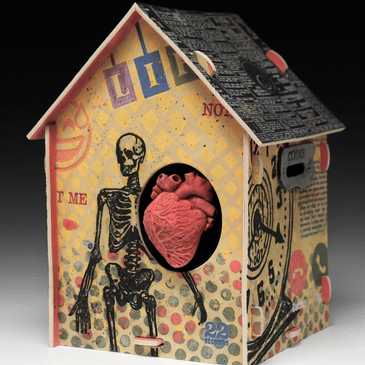
In this episode, Bob talks with Frank James Fisher, a potter based in the USA. They talk about Frank's journey with colour and his energy for his work in which he uses strong images and surface design.
[00:00:00] I love the control, I love the way they're applied. I'm abusing clay in ways I never thought that I could with them because they're basically sort of glaze, sort of a clay and they can touch the kiln shelf and that stick. It's just there's a whole lot of freedom
[00:00:20] Welcome to the Colour and Ceramics podcast. I'm Bob Acton and I'm glad to introduce Frank James Fisher to our show. Frank is an outstanding ceramic artist living in the United States
[00:00:33] His professional background in marketing and graphic design has sparked his interest in the mass communication in our society today
[00:00:42] Headlines, promotional copy, logos, branding and graphic design have all found a second voice in his personal art. The artwork borrows the language and advertising images of American culture and manipulates the content into a deeper narrative of a life
[00:01:02] Serial and random associations between images like Coca-Cola, handguns, product instructions and newspaper headlines Direct people through a personal journey of picture associations. We talk about his journey in art up to his current work with pop artifacts and flasks
[00:01:23] But of course we touched on his use of dynamic color strong graphic design and form. I hope you enjoy the show Welcome to Colour and Ceramics the podcast for ceramic artists who want valuable ideas about using color from leading artists and world class experts
[00:01:49] Here's your host Bob Acton, a sculptor and ceramic artist who's fascinated with color and help potters, sculptors and artists use color in their work Tuning is he talks with his guests about color techniques and the impact of color on people and art itself
[00:02:05] Frank, thank you for joining us on the Colour and Ceramics podcast excited to have you here today To talk about all these things color based surface decoration based and I got to tell you I love your work
[00:02:20] I have spent time looking at you know some of your you know, I would might call them more traditional ceramic pieces, functional pieces, you know, bowls and platters and teapots and so on
[00:02:32] And then you have these fantastic things you call teacans and we'll talk about those at a second right but Those are wonderful pieces and so I'm excited about having you here on the show
[00:02:45] I'm really I'm really glad to be here. I followed you so it was cool to see the whole Take your taking with color and Ceramics because I think there is kind of that gap that nobody's really stepped in and filled so when I saw that that was great
[00:03:01] And then when when we exchange DMs there about maybe get not I said, oh this is going to be good we get to do a little in person talk Yeah yeah, yeah, this will be great this will be great. So I wonder if we could
[00:03:14] Start off a little bit by you telling the people who's listening about your journey like what what's your why what's your reason for doing this Where where if you come from and what brings you here today
[00:03:30] Sure sure. I grew up in a family with my father was a painter using artist so art was sort of an accepted
[00:03:39] Element in the in the house. It was not it was not that I situation and I watched him he was a painter and I went to school and Study painting I studied graphic design he had it
[00:03:55] Our cataloging house they did catalogs and things like that. So that was going to be what I did for a living and the art thing was going to be on the side That's what he did And as we went along
[00:04:10] The art got more and more exciting for me So I went and switched the over into into marketing and in marketing colors huge so and I I'd always love color I was afraid of it at first It's it's it can get out of hand real fast But The
[00:04:35] When I study painting you get it I stayed realism and I moved into abstraction but in in realism You kind of really got to know your stuff if you're going to pull off a convincing illusion on canvas and that was probably my training
[00:04:49] Was as far as understanding color wheel and the tertiary the secondary primary and endless and in monochromatic And all that that was really where I got my foundation
[00:05:04] And then I when I moved into abstract and that kind of freed up my brush and taught me more about the balance of the image and the you know the golden circle and all this these things kind of came together
[00:05:17] And it wasn't until I tried in high school ceramics but it was a miserable failure I liked three to mention a art and my father said when your college makes history take some ceramic courses which I did Good for him. Yes, yeah very smart man
[00:05:38] But I was afraid of color still at that point so everything I did was white You know you're gonna give it a good dip so I got my I got my forms down but everything was pretty much white And then it was probably around 25 years ago
[00:05:56] I took a course at school craft college in the Go and you miss you again And in ceramics and that's when it bit me again and I've stuck with it since then
[00:06:09] Very cool. Well, we're all glad you did you know that's very interesting that you bring up this issue of color Provoking some anxiety in us right and because I it certainly did for me
[00:06:22] I would work on forms to make sure the form was right and that I'd go to apply some color And my hand would get a little tight and And because I was worried about wrecking the piece I guess was back there. Yeah, yeah
[00:06:36] Yeah, you'd spend months making all these pieces and they'd accumulate on your shelf And then it was time to put some color on them and It's very daunting because you got a big investment in time and shape and some of those things
[00:06:53] You're not confident you could make again not to the degree that they were So yeah, there was There was a point there where I got so stressed about doing Because I would try to make it so perfect when I was glazing and I got kind of stressed
[00:07:13] And I was glazing at the studio that at school craft and I looked down and I didn't know what I was going to do and I looked down there's a sheet of bubble wrap And I plucked the bubble wrap right in the glaze
[00:07:27] Drain it off real good and then I slapped it around the bottom of the piece and pulled it off And it had this incredible pattern and from that Really that point there the decorating was okay with me You know I crossed the bridge or something there
[00:07:48] And all that abstract background and the painting background And everything came flooding in and it kind of became the two we came one Is you know bringing the brush and bringing abstract Bring patterns being reckless being a little casual with it and seeing what happens
[00:08:06] And that was a that was a good moment for me. That was a pivotal point That is so it's sort of being afraid of jumping off the highboard In a swimming pool He just have to sometimes do the first one right and then realize you're not dead
[00:08:23] It's okay the piece hasn't been wrecked Everything will be okay and that's a sense of freedom then That you really get with using color in this case But other things as well I think it can become very OCD about it Everything just so precise
[00:08:42] And that experience and one's after that where I was looking around for anything in the house And the hardware store anything that I could use as a glaze transfer unit To add or not things That was kind of the obsession And all I really worried about was
[00:09:00] Did I get enough glaze on the inside that it would be safe food safe And I did I do a really nice job trimming the foot And then everything above the foot Everything that was above The foot to me is kind of the
[00:09:16] That's the connection to the real world That's the little pedestal And everything above that is a free for all And so that that approach Really you know loosened up all those mental anxieties I'm going to put on it and I'll have fun on the top
[00:09:38] So that's very good Another potters would respect that because often when you see somebody walking into a gallery And turning a piece over and looking at the foot you know they're a potter Yeah Can't we refrain from picking up that pot
[00:09:54] Yeah, hey so tell us about your work like you've got these at least as I see it to Sets of work. Could you talk a little bit about the forms you use and and Where that came to be sure I started out With functional
[00:10:12] Tea pots. I really love tea pots And I did a lot of tea pots And I had in the neighborhood Like 20 minutes away was John Glic the creative computer and And
[00:10:26] I loved his work. So I modeled a lot of my early stuff after that keeping it very functional But trying to be free But I got frustrated It felt like I was trying to measure up to what he would do
[00:10:40] And that really tapping inside to what I wanted to do And as at a flea market I saw these old rusty gas cans and I don't know if the dime drop The levers all clicked in the right place
[00:10:54] And I just saw a giant tea pot in the shape of a gas can And And I said you know that might be kind of interesting to kind of explore that So I got the forms and I did them in in porcelain And I was really into raccoon
[00:11:10] Around that time and Like you said stepping off the diving board You know I got a porcelain piece I'm going to use raccoon glazes And I'm going to rack hoop fire it And I had a porcelain piece with sharp edges because I was trying to imitate metal
[00:11:28] So none of it was I was definitely off the board there There's nothing was in the safe zone And it just a miracle I had the right kind of clay It had a A lot of good grog in there
[00:11:44] In the porcelain there was a malachite that kept it together Everything was worked out And that was my next few years was these these teacans Yeah they're gorgeous And as you said that was really risky using porcelain And raccoon Like that is a danger zone
[00:12:04] Most people would get it to right off the road Yeah It was it was at a class period And we were all friends But a lot of them wanted to come out And see you know we were firing outside
[00:12:16] A lot of them wanted to come out and see the results Yeah But I think there was something that was almost like going to see a car crash You know what's on Well how bad will this end up You know It's not wonderful
[00:12:30] Yeah I felt like I had a good direction Yeah absolutely I mean they're gorgeous How do you with those in particular Manage the sort of relationship between the form And the color because your work has a lot of illustration on it In fact I
[00:12:50] I thought as you as I was looking at your work You're really a mix between a potter And a print maker Because you're using lots of print making techniques Applying I'm not sure yet you'll tell me what it is But like an under glaze or something on there
[00:13:06] Can you tell us a little bit about that Sure First thing I would quite say is It was lucky I met John Murphy, John Albert Murphy He was good and very good in raccoon And he was pointing out different things That would happen
[00:13:24] If you under fire it slightly it would go mad And different different weird oxide combinations And I knew and met Robert Pipe and Bird Another great raccoon Artists out that way There's a lot of things that just kind of came out
[00:13:42] Right for me to get the right glaze Is the right colors And a lot of experimenting And things like I said I had that abstract background So if you're familiar with abstract art There's a color field painting There's this like Rothko And those were
[00:14:00] There's a lot of looseness within the area And that would be That would be something I kind of defined on the form of the piece Is that the front panel Which would be the primary panel Of the can And I think in terms of packaging
[00:14:18] When I do these But that front panel Would be an abstract area That would be monochromatic with colors So it might be red Because I want to imitate a gas can So the front panel would be red And I would have a lot of fun
[00:14:34] Dabbing and splashing red Glases on there And then the back panel I would determine would be white So I'm defining a ceramic piece The same way I would design packaging Or anybody would design Packaging like a gas can Or something like that So I'm borrowing all this
[00:14:54] Advertising marketing Guidelines And I'm wrapping them around a ceramic piece So in some ways it makes it easier Because you're sort of cheating There's some parity to it in that But at the same time Once you've kind of outlined The areas that are going to be Graphic
[00:15:18] You can have fun in those little Jigsaw pieces And decorate in that way Yeah it seems like you really made Your own surface your own Piece to work on Right? Yes. I am this my guess I did This the brush I couldn't get the brush To be Precycinoth
[00:15:44] When I would paint these Paint when I would glazes And I started getting into stencils And I was familiar with stencils Because I had worked as an illustrator With an airbrush And if you're an airbrush illustrator That's one of the tools is having Stensels or friscuits
[00:16:02] That you would spray to contain your paint So I started cutting out What I would basically do Is buying a gas can Like mobile with the Pegasus horse And I print out on a sheet A X-paper of Pegasus To the right size and I take my exact
[00:16:22] To knife and I cut it out And I put some spray glue on it And I press it against the can And that would block any glaze From going where that That Frisket that Stensel was And so I would splash all my colors My reds all around that
[00:16:40] And then I just peel it off And I'd have nice bare clay there Which I could put a coat of white crackle over Something like that and that would preserve the white On it there So all that was done with stencils And you can go to
[00:16:58] You can go to like a hobby lobby Or hobby shop Craft shops And they have Precut letters that are at heset Like for scrapbook people in that And with five bunches of those and I would spell out You know like five ounces
[00:17:12] Or I would spell out whatever those And I would use those as precut stencils to kind of Cheat it To cut to it faster in that So that was that was how I would get them so tight And I basically made a can As perfect as I could
[00:17:28] And then afterwards I would you know Splatterware and rub it off of a little sandpaper Or on my jean lag or Scrape it or ding it And dribble and splash Glases that look like oil Just to kind of give it that o-releic feel And a little rougher
[00:17:46] Those are that's a real complex process Making the piece in such precision that you do Then creating the canvas With that kind of abstract feel Then layering that with And you use glazes to put on all of the Yes Let her in
[00:18:06] That was my I used a combination of Custom mixed glazes like I had a A raccoon black glaze I had pipe and bird patina I had white crackle I used those but I also got into the low fire glazes
[00:18:20] Like the ones you can buy at amicol in that And I would get them hat Not that it made a big difference But I kind of liked those those colors better I would use those for all my brighter More commercial looking colors
[00:18:34] And if I had to get a certain orange like Like if you're into automotive There's a a color called Fram orange which is A more apart to that I would mix a little bit of the red
[00:18:46] And a little bit of yellow and I get just the right orange So there's a little bit of that color play And there too I get it just right Wow that's that is a lot of work A lot of precision work To do that piece
[00:19:00] And I'm thinking of many Potters who I know who make the Form and then dip it in a in a big bucket And then they're happy with it I mean the two it's a wide Extreme between that Easy process to the complexity that you're working in
[00:19:18] One thing that happened when I When I was doing these pieces Was that I borrowed something from I borrowed something from From advertising and graphic design And it made a huge difference And everything I did from then on
[00:19:34] Is is when I would sit down in the wheel and I was going to throw Whether it would be a teapot or a mod from then on I would always envision what the final design What the final piece look like color and everything
[00:19:48] So I wasn't just sitting at the wheel And building a bunch of blanks That I would decorate someday When I felt like it I was sitting at the wheel and I knew in the case of a teacan I knew that this was going to be a shell
[00:20:04] Gasoline teacan And then it was going to be yellow And I knew the top I would probably make that red And that translated to all Most of the stuff that I do now I don't really just do a blank Ceramic piece
[00:20:18] I've already kind of dedicated myself to the desire And everything that's going to happen And it's a lot more liberating And it organized me a lot better I think I thought a little I think I think a little deeper about color And all that
[00:20:34] Because as I'm making the piece With what clay I might think you know what This might be one there I want to put a little bit more blue Or a bit of more red or whatever I want the neck of this to be the base
[00:20:50] I want the neck of this to be a little taller Because I want to have a lot more Black at the top I'm making decisions in the process Because I've already committed to the final product at the end And it kind of is all going to work
[00:21:04] And streamline together To get to the final piece A lot of pre-work I might call it Before you sit down at the wheel Yes, yes And not to say that I rigorously got it planned out But at the wheel I do know Where I'm going at the end
[00:21:22] It won't be three months later I go to the shelf and I get 20 pots And I'm going to wonder what glaze is looking good in the bucket I've already kind of committed These are going to be that And I'm designing this the space to accommodate
[00:21:36] Graphics and things like that So it kind of forced me to get a little more And that's the same way that a painter would work You know if you were going to do a landscape Or if you're going to do a kind of make your decisions at front
[00:21:50] And then it's more of a time of just executing Executing your plan And what I like about that is I can kind of fine tune The decorating and the process And all that as I'm going along And not be occupying my mind
[00:22:08] Is what if this was a whole What would this color be? Or what should I make this pot or anything I'm not occupying my mind with big decisions I'm filling it with tighter decisions That makes sense
[00:22:24] That makes perfect sense and I think what I hear you think is You're really much more focused than In your work Yes, yes And I think production potters Have that that advantage too Or they know they're going to do 40 mugs
[00:22:42] 40 mugs and they know that they've mixed up a batch of glaze For certain way and they know how they're going to decorate it And I think there's something There's something comforting about that In getting into the process And that being a lot of anxiety about
[00:22:58] Every little baby step decision Because you've already got a master plan And you're executing it And you've got little spot in the 80s In between But it's not like it's a it's a Whole load of decisions I'm going to have This Tuesday when I go to glaze
[00:23:14] Because I don't even know if I got enough You know Lays from certain colors I want It's you committed to that and executing Yeah, you know often people will say It's the moment of opening the kiln Is a surprise Right? And that and again be a pleasant
[00:23:30] Surprised or not a pleasant surprise But it sounds like that the Work the process that you do to make your work Really helps you reduce that Surprise Much like a production potter might And if you know if you fire it correctly
[00:23:46] At the right temperature and the right length of time And so on then you can pretty well predict what's going to come out Yeah, you take a little you take a lot of the gamble out of it Hmm, yeah Now the work you do in these cans
[00:24:00] And I'd really encourage people to go to your website And we'll put all that information up on our page For people to check out your Instagram page and so on I love people to go and see that When I look at some of your other work
[00:24:12] That I might call it more traditional ceramic work It's got a very different feel than the precise images on the cans Can you tell us a little bit about that process? Yeah If I look back I think my functional where my traditional
[00:24:30] Tea pots and things like that were the beginning I think the tea cans were kind of a transition to be a little more free With what I do and then the final What I call my pop artifact which are kind of a combination of Slab and Wheel
[00:24:46] Um, I kind of like The next generation off of that I could have made that direct move I could have gone from just the functional tea pot To the slabware That I, that slabwork that I've done
[00:25:02] There had to be something in there that was a combination of slab clay And, um, and thrown an altered pieces in that And that's kind of what happened with those And a lot of freedom and the graphics and things like that Um, the new work
[00:25:18] Um, comes, uh, is very reliant on printing plates To make the graphic impressions And it's the old form of like letterpress Printing plates where it's actually Dementional that I can, you know, imprint into the clay And it, you know, recesses it out and I can put glazes
[00:25:38] And things like that in there Um, there's more of a sense of freedom As, as I see it in those pieces then in the tea cans When which you're trying to replicate An egg not exact but an egg more exact Form and image And now in your work
[00:25:56] There's this freedom of all sorts of graphical images And shapes and textures And yes, that, you know, that, that, that's pretty accurate Um, I, I feel like, um, if, if, if I'm going to do a piece now The, the skill set and the muscle memory
[00:26:18] And all that that I would approach it Whatever I do is going to feel like a continuation Of my style I have Uh, enough ingredients and how I approach something That it will look like my, my art Whereas if it was a, uh, a, a tea pot
[00:26:38] The shape of the tea pot is got a lot of restrictions to it Um, and basically it might only be Some little nuances of how I handled the wet clay Or did I have something that's very unique And how I glaze it
[00:26:56] The, the, the new, the new work Is so um, so, so unique so different That whatever I do Because of the criteria of how I approach it It's going to look like Definitely one of my pieces Is it, if that makes sense
[00:27:16] So there is a ton of freedom Because I feel like I don't have to Make it look like The rest of my work My process is already going to guarantee that Yeah, absolutely I really do get that sense When I see that work
[00:27:34] You know, I, uh, my background is I was a psychologist for many years And one of the areas that was always of interest To me was the notion of Resiliency and Longjava the end That help us live a long and healthy life And, and aside from eating
[00:27:50] And so on eating well and exercising One of the areas that lots of people talk about And has some good research behind it Is that we need to find something That keeps us energized Something that gets us up in the morning
[00:28:04] So I'm really interested in what excites you These days about Uh, color, pottery What, what's uh What's exciting you know What, what really changed me Was under glazes I use under glazes Almost exclusively now And I didn't come about them until about Maybe three years ago
[00:28:30] And I don't know how I missed that train You know You know, had the count and the, and the Reduction and the oxidation And raccoon and all these different things And I've seen it floating around in studios Under glazes and I just never picked them up
[00:28:46] But there's something Um so similar to Paint Like gouache And acrylic paints That I just completely love that I um I love the control I love the way they're applied I'm, I'm abusing clay in ways I thought that I could with with them
[00:29:12] Because they're basically sort of glaze sort of a clay And uh, they can touch the kiln shelf and that stick It's just there's a whole lot of freedom There so And the, and the vibrancy of the colors Um Unlike There are a lot of glazes out there
[00:29:32] That I, that I, I really like And I'm talking about traditional glazes I'm talking about a lot of glazes I really love But they don't always play well with other colors So you got to be very precise with where they're at
[00:29:44] And I might truly love a, uh, black glaze Um, but it, it doesn't play off real well Against this other Matt glaze that I like And it starts creating a different aesthetic And what I, but the underglaces But it doesn't play off real well against this other
[00:29:58] Matt glaze that I like And it, it starts creating a different aesthetic And what I, but the underglases They're always Matt They're always bright They're always vibrant You can tone them down if you want But uh, I like that And they stay where you put them
[00:30:16] It all tend to wander around Um, so from, from my background My skill set I really, I really like that And I can be, I can water and way down And use them like a water color I can keep them opaque And sort of have them in pasto
[00:30:30] So It's opened up a whole wide range for me It really is much more predictable Using them as a pasto something out Right? Yeah, absolutely Yes, yes And you can kind of tell the piece The color of it And how it's going to look when it goes
[00:30:52] Into the kiln As opposed to some colors Like if I was to talk about like licorice black Which is a cone six glaze that I totally love It basically looks like a dark burgundy When you're when you're mixing it and putting it on
[00:31:06] And you're keep trying to imagine what it's going to look like Here it's all like real life It's actual time It's, it's not as bright as it will But you can kind of get the balance And you can tell when you glaze the piece
[00:31:18] Or you underglaze the piece There's a confidence in the application There's a, um, there's a kind of a There's a, um, there's a control That has a little bit of spontaneity And a little bit of freedom But also a tightness And you can see it on the piece
[00:31:38] That even before you fired it You know that that's going to come out Because it's got some energy to it And I would have that Sometimes With other glazes With the like a cone six or Or that but maybe those colors
[00:31:56] Would run or they, you know, they do different things Maybe it's like a pumpkin orange and you know Happened to have the wrong color there and it's Run down on the shelf and I got these They're just a lot more trustworthy Yeah Absolutely
[00:32:14] So you have taken a whole variety of skill sets Painting to Colentand as you talked about it Working with glazes, Raccoon Um, at your work in marketing And graphic design and And now your work is a culmination of Of all of those Technical skills and practice sets
[00:32:40] And muscle memory I think you use the phrase I want you to imagine a person who's more On a approach to jumping off the highboard And there may be somebody who's entering into the Ceramics field or somebody who's been in the field for a while
[00:32:58] But wants to push themselves into a new Some new work What advice would you have for this person about how they should Push themselves and approach things One place that I liked to hang out Was In the classroom
[00:33:20] Was I like to see what came out of the kiln from everybody else Um I probably learned as much from that as anything And a lot of times people would be so disappointed And a piece that came out because it didn't fulfill their vision
[00:33:36] Of what they put in But I would look at it And I'd say oh my gosh the way that glazes running That's like a like a a hair fur It's or it's you know what's going on there It's almost like a crystalline
[00:33:50] But it's not that's it you know And one of the things And that kind of would get you Get me jump started on a lot of things And it would it would lead to More exploration As these proposed failures That that were out there
[00:34:08] The other thing that has really helped me a lot Is working in a series So if I'm going to do I do Like little flasks Or I do like a plane I will Work out what my color palette is going to be
[00:34:26] And I will jump into it and I'll do five or six That are almost identical But they'll have some variations on it And the variations will be It might be in how I print it It might be slightly different color
[00:34:44] And in some of the secondary colors that I use on it It allows me the freedom to experiment And that feel like I'm gambling everything on one piece Because I've got maybe five that I'm going to put in And because I know that
[00:35:02] I'm going to have a loss in there I'm not so stressed and I'm going to take some chances With those I'm going to make sure that I'm going to try to jump off the board And see what it is Do four or five of them
[00:35:18] And play around with it Keep them maybe 80% the same And just do some variations with them But that series is very liberating It is isn't it I find the same And as you get closer to the end piece If you've got your five or six
[00:35:34] It starts your feeling And the way you approach the fifth or six piece At least for me feels different Right? Feels more free in lots of ways Yes Yeah and there's some things that you might have learned On how you poured or dipped the glaze
[00:35:50] On the first two that by timing to that fifth one You've got a little learning curve on it So that one is going to be similar But it's going to be a little different And then those five pieces I'll stick them on the shelf
[00:36:02] And I'll keep looking at them for a year Because some of them did turn out The way they were supposed to When I put them in the kiln But after a year I kind of warmed to them and it's like Oh, you know that failure was
[00:36:16] Was kind of good over here on the backside I got my notes I think I'll go take a look at that again That yeah It's a happy mistakes But just be able to recognize it Thank you You think I've very appreciate
[00:36:32] Just spending some time with us here today And I wonder if there is something That you think you'd like to tell the audience About color and surface decoration that we haven't covered I think If I was to start over again The first thing I would do
[00:36:55] Is I'd buy myself one of those little Diling color wheels That you have that has All the different colors on there And I'd buy myself a couple of books about color And what colors work good And there are books out there that I know you enjoy
[00:37:09] That would be the psychology of color And I'll show you palettes that are Demonstrate or vain colors Those show you palettes that That are more nostalgic or more romantic And kind of learn about that Because I think that whole color thing You can
[00:37:29] Before you even pick up a piece You will recognize the color And you might not fully Understand the form But that color is going to send you a message And if you can kind of get a handle And how do apply color and use color to your advantage
[00:37:45] A lot of terrible pieces Can look a whole lot better And I think it'll take a lot of stress out of Actually sitting down in the mixing room with a glaze Ruin put stuff on And dealing with it Yeah developing that knowledge
[00:37:59] I think is what you're talking about It really helps you because I think color Provox and emotion in people Provox us to have an emotional reaction to the person And as you said different colors Produce a different emotional reaction to us Maybe even at different points of time
[00:38:17] So being able to have that technical knowledge Is really a different way So being able to have that technical knowledge is really critical Yeah to kind of understand it And you probably experience this too Because you use a lot of color in your sculptures
[00:38:33] I know there's days that I'm going to I should be going down there And I should be doing things In reds and browns For that particular piece And I can't do it that day Emotionally I'm not in a red brown I don't know I'm not green
[00:38:51] I'm just set it aside So even you have to be You know as the receptor You have to be in the right emotional place There are times when I just do not have An aggressive color field to me I'm very tone down
[00:39:07] And that'll be a different type of piece So to me it isn't just an automatic plug and play You got to kind of be in the right mind frame To experiment You know if it's a real active palette Or if it's a real subdued palette To, you know
[00:39:25] Like I really sense a maturity in you I guess I would use the word When you are able to be aware of yourself Enough to know that I'm not in that space And I need to honor that And I need to get into a different Bit of work
[00:39:43] Like that's a maturity Rather than sort of saying I'm going to do it anyway And I'm just going to jump ahead Yeah The other thing too Is it will take the joy out of it for me Because I start feeling like I'm a factory
[00:39:56] And that regardless of what's in front of me Or how I should have Emotional Connections to the piece That If I've just got to get that thing glazed This morning And I'm just kind of doing a job I'm not really making that piece special Yeah
[00:40:15] That joy is gone Yeah I'm just following a blueprint And I don't want to like Triple over what I said before But at the same time you've got to be into it You've got to have the joy to it Awesome What great thoughts we've had here today Frank
[00:40:34] I really appreciate you spending some time with people And I'm sure people will be very excited About checking out your work And thinking about many of these things As it approaches their work I'm glad that was one star I guess that talking to a color guy It's nice
[00:40:51] It's a lot of fun Awesome Thanks so much Thank you Bob Thanks for listening to the color In ceramic spotcast With Bob Act and And his guests Please help others find the podcast By subscribing to this podcast Wherever you find your podcasts Such as iTunes, Spotify
[00:41:11] Amazon, Music, YouTube Or other pod catchers And don't forget to give us a review We'll see you next time