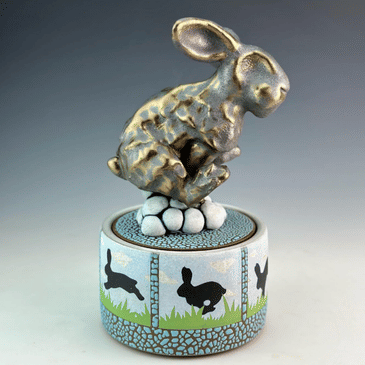
In this episode, Bob Acton and Lisa McGrath had a great conversation about her beautiful work. While we talked about her functional and sculptural work and her approach to colour and surface design, she shared an interesting story about how her use of a coloured lichen glaze came to be,
You can find more about Lisa on her Instagram Page here https://www.instagram.com/ipotlisa/ and on her website https://www.bramblestudio.ca/
I hope you enjoy the show!
[00:00:00] I am so fortunate and grateful that I get to be a regular part of People's Days. There's a reason that they go for that, that certain mug or that bowl.
[00:00:12] And I really think it, I hope it has a lot to do with how it feels as much as how it looks. Hi, I'm Bob Acton and I'm pleased to share my conversation with the wonderful Lisa McGrath.
[00:00:25] Lisa completed her BFA in Ceramics from the Alberta College of Art and Design in 1997. And she's currently a Potter in Calgary, Alberta, Canada. And she uses intense color and complex surface designs to create wonderful pieces with many of them having an additional sculptural component.
[00:00:46] We talked about her journey and clay, her use of color and surface design, of course. And she shared some technical ideas, but I think you'll connect with the deep reason she started using her lichen glaze.
[00:01:00] You can find Lisa in her various online locations in the show notes and I hope you enjoy our conversation. Welcome to Colour and Ceramics, the podcast for Ceramic Artists who want valuable ideas about using color from leading artists and world class experts.
[00:01:17] Here's your host, Bob Acton, a sculptor and Ceramic artist. This fascinated with color and help potters, sculptors and artists use color in their work. Tuning is he talks with his guests about color, techniques, and the impact of color on people and art itself.
[00:01:34] Lisa, thank you so much for joining me Colour and Ceramics podcast today. Thanks for having me, Bob, I'm very excited to hang out with you for a while. Yeah, this will be great, you know? I love your use of color and surface design in your work.
[00:01:50] And as you know, I've got a few pieces of yours in the covered downstairs that I use on a regular basis. So, you know, not only do I love that I'll call them intense colors, I guess, that you use.
[00:02:03] And also that textural work that you do with some of your glazes, but I also really like those sculptural pieces and a little bunnies and stuff that you're got on the things. So I'm super excited about having you here today. Yay, well thank you. Yeah.
[00:02:20] Hey, you know, this work that you do really represents years of work in clay. I don't think you started it just yesterday. And so I wonder if you could tell us a little bit about your journey. Like how did you get to where you are today?
[00:02:38] Sure, I attended the Alberta College of Art, which is what it was called way back when I attended in the late 90s.
[00:02:48] Went through four years program under Greg Pace and Sally Barbie there, which was a really nice mix of really highly refined wheel throwing work that Greg Pace does. And Sally Barbie was a sculptural artist at the time using many different elements that she would bring together.
[00:03:07] Sort of hang things and so I feel like I had a really good mix of sculptural and functional influence there and straight out of art school. The Alberta College of Art in my final year became the Alberta College of Art and design, so they were given university status.
[00:03:29] So I think I graduated in 97 and then I went back for a semester to pick up my degree since it was just a few extra courses and came out of there and started working for an art center, which was amazing and continues to be amazing.
[00:03:44] I've been there for 26 years while flower art center. And you know, I think I can probably thank the art centers quite a bit because I have always been fortunate to work around creative people.
[00:04:00] Many many creative people and having many influences and I think it definitely kept me propelling forward with my work. Yeah, so I guess that's where I'm today it's been let's see well I graduated in 97, so it's been quite a while that I've been out this I guess.
[00:04:18] And it's been a few years and it's neat I've started my journey in clay at the Welflower Center years ago.
[00:04:26] Oh, did you really? Yes, yes absolutely that was my first I had always wanted to be a potter and then years later in life I said that's it I better do this and so I started taking a class over there and maybe first few ash trays if I recall.
[00:04:41] Wonderful. It's a good place. Yeah, it's a great place. Absolutely. Hey, you know, I'm really interested in what inspires people and so I wonder if you could tell us what is inspiring you these days about the work that you're making.
[00:05:00] Yeah, you know, I feel like it's mostly about surface design for me right now.
[00:05:09] The program looks is moving into this sort of area where everyone the technology is sort of driving everything forward and there's so many layers of color and pattern and we now have so many materials that are fingertips that I feel like you know you just jump on to Instagram and you see all of these magnificent potters out there doing all these wonderful layered things with their work and and I guess I guess that's what really inspires me.
[00:05:37] These days, but you know going going way back I you can probably tell from my work I've always been inspired by you know the natural world around us even I are both fortunate to live in Calgary where Albert Canada where we're so close to the mountains I actually live just on the on the very west edge of the city so that I'm in the mountains and literally I think 40 minutes we're in Canmore.
[00:06:05] And you know the mountains, the forest all of the little critters that live within I do have a lot of little critters in my artwork also you know really up close often when when I go for hikes and stuff.
[00:06:21] You know spend a bit of time with some like in on a rock maybe sandwich and really look at that which I think you can also see in my work because.
[00:06:29] With my work it I really want it to be very visually stimulating but also physically you know I want that cut to feel really nice in your hand so.
[00:06:40] I use the liking glaze often on almost everything that I make with the exception of sculpture perhaps because it's really about how it feels as well as how it looks for me.
[00:06:51] And there's some beautiful things there has as that taken you a little while to learn some of those techniques that you're using.
[00:07:00] For sure quite a while I mean going back when I was in my final year of art school they really wanted us to focus on what our.
[00:07:11] What our thing was you know and and I can remember having a a serious sit down with one of one of my professors and him saying you know are you a functional partner or are you a sculptor what you know what are you make your mind up.
[00:07:25] Yeah exactly and I was like I don't want to choose.
[00:07:28] I think I think I did wind up going to sculpture root for my final year though but once I got out of art school I was like I'm both I have to be both I you know I get a lot of satisfaction out of.
[00:07:42] Building a sculptural form I usually use animal forms to sort of convey emotion and a message that's why I love rabbit because rabbits have so many muscular features behind behind their faces that you can really convey emotion. They're not really rabbits look kind of people you know.
[00:08:02] I'm sculpting rabbits but I'm kind of sculpting you know rabbits with with. Answered for more precise sort of emotion and and thought behind them I think.
[00:08:11] But I really get a kick out of being able to convey that sort of message and people looking at it and wondering you know what is what is what is he thinking about what what is going on there but also.
[00:08:22] I definitely get a nice dopamine rush from building a very functional teapot you know so I kind of have this split personality that's some you know with the sculptural and the and the functional sometimes they converge but most of the time they don't.
[00:08:40] They look like they converge pretty well for me. I don't think you should be so hard on yourself the.
[00:08:49] How do you so one of the challenges I think that we have is managing this relationship between form and color surface design so how do you think that through when you're doing your work.
[00:09:05] I think as many of us artists do I draw everything before I even think about making it so.
[00:09:13] You know all sketch out the shape of a mug and then I'll figure out what kind of patterns will work best on them and you know how the blaze goes so that I've got.
[00:09:24] Almost a formula of making that mug before I even start just because everything has to happen in a certain success of order. I have very limited time in my studio because I do have a full time job at the art centers and that lovely creative space.
[00:09:41] So when I when I do have my studio time it has to be it has to run like a finally grace wheel or grace machine I guess. Yeah so I don't know I'm looking at a mug right now and trying to think you know how I guess.
[00:09:58] Like I said before I really want it to feel very nice but I also want it to be really visually stimulating so.
[00:10:05] So you're you've said a few things there so that I've got a few questions for you so one of the things I hear you saying is that you're focused on making the piece itself functionally and it's got a feel right in your hand.
[00:10:19] And or or however whatever piece or make is going to have that form that's just right and then you think about adding the color and surface design.
[00:10:31] And you use different kinds of things in your surface design if I understand correctly you're using some glazes and some under glazes and and without giving your secrets away although you may want to give your secrets away.
[00:10:44] But what are some of those techniques that you talked about that you need to layer through and you're when you're great so. I just in the past year and half I guess I sorry I'll start over again. I use a lot of pattern with bright colors.
[00:11:05] I like to live my life thinking that I'm a fairly happy person and I guess I want my pots to convey that that as well I want people to feel happy when they look at them.
[00:11:16] So for the most part they're they involve really bright colors and different layers how I get my layers is through paper decles and that kind of thing so.
[00:11:29] piece is made all that I focus on is you know throwing it making a nice handle that fits really well in your hand.
[00:11:36] I like a really big mug so you know I'm gonna throw that first piece and hold it and see how I feel about it before I put the rest of the mugs handles on.
[00:11:45] And then everything gets best and then comes the decorating stage so then I start in with my under glazes and I will also I'll often use one of those decorating discs and I'll divide my forms into different sections say six sections.
[00:12:02] I'll decide which sections will be reserved for form I usually call my blue bubbly glaze but it's it's a type of like in glaze or articulated glaze. And that's the tactile kind of portion of it those I leave blank and then.
[00:12:18] I'll have all my different paper decles and I'll start by just adding color and then adding decles adding more color more decles more color so I usually wind up having about two to three different layers of color on those sections and then the piece gets best again.
[00:12:37] And then after that is is the glazing and the reticulated glaze that I use is really. What's the word it's a bit of a pain of the thought to work with true featled so that reticulated glaze in order to make it really work well.
[00:12:57] I have to mask off the sections that I want to be glazed and I use an auto body tape because it's got a little bit of stretch to it so it'll go over curved surfaces and it'll stick really nice because I'm a sucker for nice clean lines.
[00:13:14] And then I'll wax the handle out mask off all the all the decoration and the color that I had done in the last fist firing.
[00:13:23] And then I dip it into my reticulated glaze and I put it directly into the kiln so that I never touch it again because if I touch it again some of that reticulated glaze will fall off and sometimes it does fall off.
[00:13:38] And luckily it's organic enough I think looking it sort of looks mossy that if a little bit of it does come off it it's still okay with the piece.
[00:13:48] So I guess that also points out that I also have to plan how my kiln load is going to be loaded before.
[00:13:55] It might have before I even start so I know that the bottom of my kiln is a little bit cooler so I'll put my my taller vessels in the bottom and then and then shorter on top so that everything gets cooked nicely.
[00:14:10] And then usually when I load my kiln I have a little bit of chipping to do because that reticulated glaze falls off. But it's a labor of love. Yes yes, so there's lots of stages to your pieces.
[00:14:24] There are a lot of stages yeah and I feel like the further I get in my practice the more stages I get myself I think. I just must work towards making things a little more streamlined that's not the way that my brain works.
[00:14:37] But it sounds like you really need to be pretty efficient I think you mentioned that before, right, but if you're working with all those different levels I guess then you really need to be sharp about. I got to do this first then I do this and so on.
[00:14:53] Yeah, which is why that planning stage my my sketchbooks are just full of notes it's funny because people will grab my sketchbooks and say oh can I look at your sketches and they think that they're going to see some cute little bunnies or something like that but it winds up just being.
[00:15:06] So many notes underneath because it's essentially it's a it's a plan from beginning to end because. These things take so many different stages yeah only three firing, though. Just three and so do you.
[00:15:22] Do you work with a series of pieces or are you tending to use work one off pieces how do you do that? That's a good question. I do tend because my time is limited in the studio and it's it's my very favorite past time.
[00:15:40] I do tend to you know spend two solid days where I will just will throw two full kill loads or two or three days.
[00:15:48] Yeah, so all wind up having like 30 mugs to decorate and and mark my words the decorating process takes phenomenally longer than than the actual making process.
[00:16:00] Yeah, so I will likely you know let's say in a given month I'll spend probably maybe four days will throwing and the rest of the months will be decorating. Yeah, because that doesn't take quite a while. I bet it does take quite a bit.
[00:16:17] You know one of the words that's popping into my mind. I don't know if this relates to you or not, but you must have a lot of patience to be able to manage that process.
[00:16:25] Do you feel that or is it I think so yeah, I think I have a lot of patience. I also you know. Ceramics can be so volatile even after I've been doing it for you know 30 plus years and I'm just really good with letting things go.
[00:16:44] That's I think kind of part of the process as well is that you know patience for sure but you know sometimes if that.
[00:16:53] If I here's another little it goes secrecy of that like in glaze if I don't wait long enough for the liner glaze to dry at least 24 hours.
[00:17:05] The liking glaze will all fall off in the can as it's heating up because for whatever reason the pot has to be bone bone dry again before I can glaze again and sometimes I have tried to push things for sure you know if there's a market coming up or something like that and I just really you know maybe I'll.
[00:17:22] put it in the kiln for a couple of hours on 200 to get it to dry a little bit and I think it's dry and it wasn't then I just wind up with a kiln load full of lots of shelves to chip.
[00:17:33] So I have learned over the years just to. Just to let ceramics dictate really what my schedule is. Yeah, that's nice. I keep thinking that somebody out there maybe a god keeps giving me the opportunity to learn patience by getting into clay like it's.
[00:17:56] It's so challenging with all of those different components that you talked about right there's the dryness there's the form there's the color there's the.
[00:18:05] But you know the kiln work all those kinds of things so that when we actually get a piece out of the kiln that's pretty and does exactly what we want it's it's a miracle in some way.
[00:18:17] It really is you know and then you know clay companies do things like change their. recipes and you know we can no longer get certain ingredients for glazes anymore you know right now there's a.
[00:18:32] I've got to sleep or I issue and and yeah and then we're sort of doing this all over again. Yeah, it is a labor of love by we used to joke in art school that might get to the blood and.
[00:18:45] You know when I was in art school, I certainly wasn't going to go into ceramics. I was going to be a photographer but. Then I found out how much the camera cost.
[00:18:56] Yeah, very cool while I'm really glad you stuck it out in play is you know I think people once they hear this episode and start to search out your work. They'll see how beautiful it is.
[00:19:09] You know one of the things that you said a little while ago is about maybe the emotional or psychological impact that you wanted from your work and talk a little bit more about that.
[00:19:22] Yeah, help people understand that for sure I am very fortunate that I will often hear oh that's my go to mug oh you're at least some a graph that's mug I use every day.
[00:19:34] And I don't use my own mug so I don't know why I don't use my own bugs I like to use other people's nuts but it's it's just.
[00:19:45] I'm so fortunate and grateful that I get to be a regular part of people's days there's a reason that they that they go for that that certain mug or that bowl and I really think it.
[00:19:58] I hope it has a lot to do with how it feels as much as how it looks. I'll tell you a story about the articulated glaze that I use. My I live here in Calgary and most of my family lives in Southern Ontario.
[00:20:16] And in order to share myself I would of course send ceramics home you know for Christmas is in birthday presents and that kind of thing over the years and many years ago my grandmother was you know getting on and starting to.
[00:20:28] to go blind and I suddenly didn't have that connection with her where I could send her a piece of myself because she couldn't I know she could still use it but she couldn't see it anymore.
[00:20:39] So I started thinking what's the way that grandma can still see these pots or just some way that she can still enjoy them and there happened to be a glaze club happening at the art center that I work at.
[00:20:51] And some of the people were just sort of dabbling with triaxial blends which is just three different ingredients and seeing what those ingredients did.
[00:21:01] How they interacted with each other and one of the students was sharing with me that she was working on sort of a type of root or a type of articulated glaze and a light bulb just went off like oh. That is a way for my grandmother to enjoy.
[00:21:19] Looking with her fingers at the pots so I asked her to share her.
[00:21:27] Recipe with me and ask her if it would be okay if I sort of took it and ran with it made it into something that I wanted and she was like you know go for it. Which was very nice for her.
[00:21:38] It's had many iterations over the years and I finally landed on the sort of texture that I like it's it's not dry.
[00:21:46] As most like in places do feel dry this is sort of around it kind of pubbly kind of feeling and and I was able to send these these items to my grandmother and she could feel it and really enjoy it and she really appreciated it and she could she could see she still see my pottery through her fingertips and.
[00:22:06] You know. It's a funny way of making accessible pottery I guess but yeah what a great story.
[00:22:13] I think that is really lovely about not only your love for your grandma and being able to connect but to manage to modify your work to be able to let her experience it in a tactile way that's.
[00:22:29] Yeah she is long gone now, but the I think this this glaze will probably stay with me forever. I actually think this glaze is how people recognize my work.
[00:22:39] For the most part so you know it it'll last so yeah thank you grandma that's yeah that's grandma's glaze as probably that's probably true I bought a mug of yours years ago and I loved it so much but I couldn't figure out who made it I couldn't remember and I eventually got back to you through that like and glaze seeing your other bits of work.
[00:23:01] Oh it's Lisa's mug yeah that's cool yeah yeah you know I'm really love being out in the bush and as I call it and and being in nature and connecting with with animals and these days really paying attention to biodiversity and those kinds of things that are really important I think.
[00:23:25] How do you want your little rabbits and other critters as you call them to how what kind of impact do you want to have on people with those.
[00:23:36] I guess I want people to see themselves in them I want them to bring them to a happy place like I said for the most part.
[00:23:46] You know I had kind of a challenging upbringing and one day I just sort of woke up in my early 20s and thought I'm I'm the only person in charge of my life now and I'm I'm gonna spend it being as happy as I can be.
[00:24:01] So I guess I guess I I am trying to give people happiness in a way sometimes my bunnies tend to be a little bit dark sometimes they're done they're not always super cute but you know maybe there's a story and there and maybe people can identify with whatever that story is.
[00:24:20] Yeah, yeah I don't know also I make a lot of.
[00:24:26] Rabbits I thought eventually I would probably move on to something else but it seems pretty stuck on rabbits still right now which is okay and I'm gonna keep exploring that but in my more sculptural work I am exploring the idea of.
[00:24:42] The happiness and rabbits and home because I build a lot of build a lot of rabbits with structures on their backs you know building sort of park scenes almost like they're.
[00:24:56] The ecosystem but they're traveling ecosystem and they're bringing home with them wherever they are so I haven't quite worked out exactly what that means yet haven't written on it artists statement about it yet, but.
[00:25:10] It's definitely something that I'm exploring the idea of rabbit and home yeah I did have a little studio bunny for quite some time to.
[00:25:19] Turning was Lyloc and she was my daughters rabbit when she was about six but soon became my rabbit as most I think children's pets do. Yeah yeah and she.
[00:25:31] So I was gonna say she lived to be a ripe old thirteen years old she didn't she didn't find out that rabbits life expectancy's were much younger.
[00:25:39] Yeah so I had a model in my studio for many many years very cool very cool now what do you think a challenge has been for you over the years you are super successful now with your work.
[00:25:54] But can you share a challenge that you had to overcome in some of your ceramic work.
[00:26:02] You know I I'm gonna go back quite a ways but you know when I got out of our school and started working for the art centers that sort of took over my life for a little while.
[00:26:14] I started building my life because I was quite young then and had a child and found.
[00:26:21] That while she was little I didn't actually touch any clay whatsoever there was probably about six years where I didn't feel like an artist anymore I was a mom and I would not give that. Those those years up for anything.
[00:26:35] I worked my words but when I when I came out of that and you know found she was in about grade one or two and I thought I have some of my own time back again.
[00:26:45] I'm gonna be a ceramic artist again, but I had no idea even where to start I didn't know I didn't know what who I was or what my thing was you know like what is what is my body of work look like I had no idea and I had to start I had to start from scratch all over again.
[00:27:06] But you know working at that art center there was so many wonderful creative people around me that just propelled me forward one person.
[00:27:17] Mindy Andrews just sort of took my hand and she's like let's go let's do this we could do together let's go you know she just sort of pushed me forward you know keep keep trying keep doing things so you know I think I probably spent a good two to three years figuring out what what my work looked like again.
[00:27:35] When I did figure it out and thought well I might have something here that's when I really started you know getting into what you see today. Right now I'd see what my biggest challenge is is definitely time.
[00:27:48] You know I I really appreciate that job at the art centers and the people that I get to work around and the fact that it pays my mortgage so well. But I wish I could have a lot more time in the studio I think most artists feel that.
[00:28:05] It happens to me mostly at night but I think most artists get this feeling that you know there's this thing in my head and if I don't get it out I'm going to make myself crazy I'm going to go crazy.
[00:28:16] But sometimes I have to tell myself just to calm down because you know it's Monday and I can't get there until Friday so just you know.
[00:28:25] I keep a sketchbook by my by my bedside so that I can write everything down and sometimes I'll have to Google images in the middle of the night. I woke up the other night thinking oh I'd really like to build some rabbits sitting on Victorian stools.
[00:28:42] I don't know why but I had to Google some Victorian stools at three o'clock in the morning and then I could go back to sleep.
[00:28:50] It's really funny these days though I have to say because there's so much AI generated work out there that you know in the middle of the night my fuddled up little brain.
[00:29:00] Trying to figure out whether these stools were actual stools like actual antique stools, automons, built many years ago or if they just came from an artificial place because sometimes it's really hard to tell that. It is very hard to tell.
[00:29:17] You know it was interesting that you were talking about when you got back into clay and all when your daughter was in great and great wanted to and you had you felt like you'd lost your way a little bit.
[00:29:29] And I think lots of younger artists, younger I don't know if that's the right term. Junior maybe emerging to merging are trying to find their own style and they really stick on us what is my style. It is my suffer with that for a while.
[00:29:47] Have you got any advice for people about how to deal with that idea and to find their style? Yeah, I would say like I said I was fortunate that I was surrounded by a lot of creative people and I could see you know what they were doing and.
[00:30:10] You know just be willing to try things in different styles. Yeah, you know Instagram is such a wonderful thing now. We didn't have that back then but you know for sure take inspiration from the things that you see I think for the most part potters are pretty.
[00:30:32] Fourth right and giving I think we're a generous bunch certainly a pot looks we do good pot looks we're generous bunch but.
[00:30:41] I think you know just if you can find a place where you can be around others who don't necessarily think exactly like you but are you know taking creative steps in their own practices whether it be art or music or anything.
[00:30:56] You know if you can join some coffee talks you know coffee and pottery talks and and look on Instagram and you know maybe don't just leave it to YouTube because there's a lot of.
[00:31:09] Interesting things going on on YouTube I think but but it's it's good to get out and you know go to go to galleries and just be open.
[00:31:17] And I know when I was younger I was really seeking to figure out what my thing is I want to know now you know I really want to know now and you know now that I'm pushing 50 and I'm looking back and it's like just you know take your time.
[00:31:33] Take your time it'll come eventually just keep making work that's all. Like a couple of key things I hear you saying that I've actually heard others say and these interviews is.
[00:31:46] Try lots of stuff practice and hang around with people who are making work right and it's that it's that connection that we have with people in our community that really can make a big difference first.
[00:32:03] Yeah for sure um one of the people I work with also who you also know Susan Thorpe I remember her coming to me one day and saying.
[00:32:12] You know there's this technique where you can you can center 15 pounds of clay on a wheel if you just center five pounds at a time.
[00:32:19] And I was like what are you talking about and she's like we should try it let's try it and we just spent a day you know trying to make really big forms with with these.
[00:32:28] You know five pounds at a time centered on top of each other and it was you know nothing professional came out of that day at all but just the fact that you know we were open to yeah let's try this and see what happens.
[00:32:41] And I think that that came out of a tonic canal workshop in the first place we saw Tony throwing these great big giant things and I remember saying to her there's no way I'd be able to center all that clay at once and she's like oh.
[00:32:54] I have a secret to show you which wasn't really a secret you know you could do five five pounds at a time so you know just being just be willing to.
[00:33:02] You know try anything even even if you know exactly what your process and what your practice looks like right now just keep trying things because you want to you want to keep propelling forward.
[00:33:15] I often have people come to me and say you know I bought this mug three years ago and I'm wondering if I could get another one.
[00:33:22] And and I always have to save them down by those made three years ago and and this is what the months look like this week because I always I very very rarely use the same patterns in the same designs on things so I hope that people view my work is is constantly propelling forward that's that's kind of the way that I do it but.
[00:33:44] Yeah. Yeah.
[00:33:46] It's like a journey isn't it and you know all you talk about being out in the mountains and hiking out in the mountains and going on paths and I started to think of our work in ceramics in a similar vein that we're going to be on a path and we turn around to corner and something new appears.
[00:34:05] And that might take us down another path and we have to just be okay with being on that path. Exactly exactly I think to if I if I could give a little bit of advice it would be keep making work for yourself.
[00:34:22] I every single piece I make is for me the fact that people think they're pretty and they want to buy them is a really fantastic bonus you know and I'm grateful for that or my house would be filled to the gills with with old ceramics but.
[00:34:37] So when I'm in the studio and I'm making mugs for a gallery I'm making those mugs for me because I. I need to get a kick out of the fact that I've made them or I don't want to put them out in the world.
[00:34:50] So yeah, I guess I guess you know just stay true to yourself and keep making work for for yourself everything is made for me and then if you want it that's great.
[00:35:01] Yeah, absolutely and I think that love or energy that you put into a piece because you love it comes out and that's what people connect with when you're at the sale. Yeah, yeah. I think so much for spending some time with us today.
[00:35:18] I really appreciate it this you've got some awesome ideas and beautiful work and and I'm sure our audience will get a real sense of you and your work and I'm sure somebody will connect with you and we'll put your information about how to connect with you up on our.
[00:35:35] Website so people can do that. That's awesome thanks for having me today Bob it was it was a fun conversation. Thank you. Thanks. Thanks for listening to the color in ceramic spotcast with Bob Act and and his guests.
[00:35:51] Please help others find the podcast by subscribing to this podcast wherever you find your podcasts such as iTunes, Spotify, Amazon, Music, YouTube or other pod catchers and don't forget to give us a review we'll see you next time.