Bob @bobacton had a great conversation with Mark Dally @markdallyceramics about his beautiful work using mostly black slips. We talked about his journey in clay, how he overcomes problems in his practice, some of his business practice, and, of course we talked about surface design and his thoughts about the use of colour.
You can find Mark on his website here https://www.markdallyceramics.co.uk/ and on his Instagram page here https://www.instagram.com/markdallyceramics/.
Mark also produces his own line of slip trailers and you can find them here https://www.sliptrailer.com/
[00:00:00] I like that steady day-to-day pack the kiln, unpack the kiln, glaze, dip everything, put it back in the kiln. There is an element of pleasure from repeatability and producing fine work that is monetarily accessible to the public.
[00:00:22] Hi, I'm Bob Acton and I'm pleased to share my conversation with Mark Dally from Stratfordshire, England in the UK with you today. Mark's initial training was in textiles at Stratfordshire University and then he got
[00:00:38] bit by the claybug and progressed into Ceramics. After he achieved his MA in Ceramics, he set up his own studio and has been applying his love of surface pattern to Ceramics ever since. His inspiration comes from 17th century Stratfordshire slip trailing mid-century
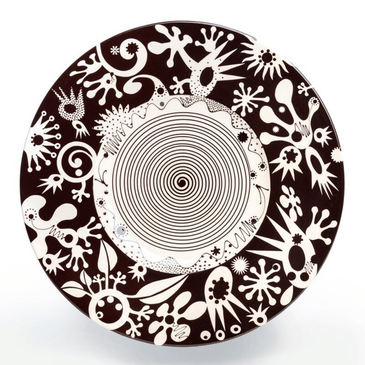
[00:01:00] stoke on trend industrial ceramics and the sci-fi and acronyms of the 1940s and 50s animations and comics. Wow, what a combination. He hand-builds cast and throws his work and his black and white wear is done with high-fired white earthenware. He and I talked about his
[00:01:22] techniques were used as slip trailing paper resists layering with slip dots, drips and linework. He also applies platinum and gold luster in a third firing to handles and knobs, particularly in his sculptural wear. I hope you enjoy our conversation and you can find out where to
[00:01:42] connect with him in the show notes and you can find all the information at colorinseramics.com. Welcome to Color Inseramics, the podcast for Ceramic Artists who want valuable ideas about using color from leading artists and world-class experts. Here's your host Bob Acton,
[00:02:05] a sculptor and ceramic artist who's fascinated with color and help potters, sculptors and artists use color in their work. Tune in as he talks with his guests about color techniques and the impact of color on people and art itself. Mark, welcome to the Color Inseramics podcast
[00:02:24] to talk about color and surface decoration. I'm really excited to have you here today. Well, it's good to be here and thank you for asking me. You're most welcome. You know, I followed you for some time on social media because I really love your work. The
[00:02:41] black designs primarily that you use on your white clay body. I'm also really enamored with the gold and silver, and I see a little bit of other bright colors in there because I think that
[00:02:58] really makes your work pop. So I'm really looking forward to talking about your work and color and surface design and sort of how you think about things. Yeah, great. Yeah, awesome. So obviously,
[00:03:14] since your work is so exquisite, this has taken you a little while to get to this. It's not like you started this yesterday. So I wondered if you could tell our audience a little bit about your
[00:03:25] journey and Clay, what you've been doing to get you here today. Yeah, sure. So I came to ceramics in a very kind of non-traditional indirect way. I did a foundation year in general art design for
[00:03:49] a year when I was 18 in Salzbrie, the fantastic cathedral city in Wiltshire, in England. And I fell in love with being creative, markmaking, drawing and then I progressed on to a BA Bachelor of Arts degree course. I think you could undergraduate and I studied textile design
[00:04:24] for three years. So I was again doing life touring three times a week. There's a lot of, I think it's been slightly lost. I think in current art college, art course environments that computers have become so prevalent that sometimes I think the pencil and paper, the charcoal
[00:04:54] and paper has kind of been sideline a little. But when I was doing my BA in the 1980s drawing was a very strong element of that. So I had a good foundation in graphic representation, graphic design, pattern making, repeat patterns. My designs were really
[00:05:23] very, very colorful. I was sort of influenced by the current music of the time, the late 70s, punk rock, fluorescent colours. There was a sort of diamond dynamism, dynamism. You can
[00:05:44] edit that but there was a sort of dynamism about that time and it was infectious and so my work had a lot of energy to it. Then after completing that I got a first class degree on us and I progressed
[00:06:10] onto strangely enough. I tried to apply for the Royal College of Art in London, I didn't get into the MA in textiles in Manchester. Then I would somebody said to me in passing, why didn't you
[00:06:33] try ceramics? Again, I wanted to carry on creating in a sort of academic environment. I started the MA in ceramics at what was then at North Staff's Polytechnic, it's now Staffshire University which is in Stoke on Trent. I'm sure probably many of you
[00:07:04] listeners will know that Stoke on Trent for centuries has been the sort of epitome of industrial ceramic production in England. Possibly the world, I think it's world-renowned. Stoke on Trent has that reputation, just the names, which were at World Allton, Minton,
[00:07:30] what Marion, their global brands. They were the pinnacle of ceramic production for hundreds of years. I started the MA and I treated it very much as a sort of fine art approach, more than a sort of designer approach. So my work was quite expressive,
[00:08:07] sculptural. I sort of went into dust pressing so I was using industrial techniques, um, collaging dust press, kind of tiles, onto wall pieces. I started casting toys, finding small toys that are quite light and
[00:08:36] far to the course was mold making. So I started making two and three part molds of small toys, and I started introducing cast toys in Perrient, Coludo, the Mybodies, and sort of mounting them on
[00:09:04] a sort of wall piece of dust press tiles, which had sort of collage, different textures and collages on. Stranging off, my tutors didn't like that at all, and tempted to remove me from the course about three times, which was unfortunately, well fortunately I'll say, I'm quite stubborn and
[00:09:36] I just carried on. The threat of being kicked off the course wasn't enough to frighten me from my path, and then the irony is after two years I got to the end, put my MA show
[00:09:57] up to display for grading. The master of arts courses in the UK are assessed from an external verifier, which meant that the grade was given to me from someone outside of the course, and they gave
[00:10:20] me the distinction. And the look of shock on my tutors faces when they announced that they'd given me the distinction in a course of 12 people was absolutely priceless. I thought sort of
[00:10:44] they didn't come up and thank me, which maybe they understood trying to throw me off three times was maybe the wrong thing to do. So yeah, I mean that was my education.
[00:11:00] I then went traveling around the world for three years, three and a half years, spent some time in in Canada, in Toronto, traveled all through the states, stayed in San Francisco for a bit,
[00:11:18] where I met my wife. Then we traveled through Japan, hold of Southeast Asia, not India, Taiwan, Malaysia, Singapore, Hong Kong, Indonesia, ended up in Australia for six months. And the whole time I was absorbing the sort of the culture, the art, the drawings, the colours,
[00:11:53] everything around me. And I think traveling is sometimes it's quite subliminal, everything you look at comes out a later time. Everything you see, you witness, you absorb it visually and store it somewhere. And I ended up after three and a half years
[00:12:19] of having a kind of creative bank of ideas and colours. And that really is field probably the last 35 years of what I've been doing, creating. How did you get from all of those colours and
[00:12:42] brilliant images that I can imagine you saw on your travels to forming black and white designs? I hadn't always done black and white, it's strange in a, I would say I'm probably known for black
[00:13:03] and white designs now. It's very much at the forefront of what I do out on a daily basis. But there have been times when I've used really bright colours with small decorative pieces.
[00:13:22] In the, I set in my studio up in the 1998, 1989 in stone, stuff here, just north of Stoke on south of Stoke on Trant. And I started off slip trailing and using quite brightly coloured slips, staining clay, slab building, really bright colours. And making small lided boxes,
[00:13:57] really just to get started just to make money, you know, just to continue. I was doing a bit of teaching as well part-time. But in the late eighties, it was the kind of boom of, and I would say American-led, glazed technology. You could buy really intense yellows,
[00:14:24] reds, bright colours, you know, in these great big sort of pottery, hobby, pottery warehouses. And I knew about them because my initial introduction to going to the states was to work on some accounts as a ceramics counselor. And I remember working in Pennsylvania in a camp called
[00:15:00] Summit Camp. It was for what is termed in written special needs children. And I got there and I was basically presented with a pottery studio with a kiln, quite a big kiln. And about 10
[00:15:22] buckets of rock hard concrete glaze with no glaze mix, you know, to kind of refresh them. And the colour palette was brown, light brown, dark brown, oatmeal, blue, light blue,
[00:15:50] dark blue. And I just, I looked at it and almost, you know, the most depressing thing I've ever seen. So I told the camp director, I said, I must go and get some glazes. He said, well, there's a
[00:16:07] place about 30 miles from here. Here's the budget. You've got quite a bit of money just by some glazes. And I went in, and of course, I'd never seen racks and racks of super bright intense colours.
[00:16:23] Really easy just to kind of brush on the outside. The special needs children didn't have to dip anything, didn't have to spray anything, they could brush it on. It was like paint. And I thought, wow, this is, this is quite impressive. But huge numbers of these amazing little
[00:16:46] pots, you know, probably well, maybe in pines. And proceeded to do the eight weeks of the summer camp. And the campers absolutely loved the richness of the colours. Most, I'm sort of generalizing now, but a lot of children go back to the same camp, you know, from
[00:17:09] the age of sort of six, seven, two, the age of 14, 15. And some of the, some of the campers were just saying, wow, this is amazing. Usually it's blue or brown. I know, you know,
[00:17:25] I'm making yellow and, and it was just, you know, the reaction was fantastic. The first few firings people were coming down to the pottery cabin and just saying, wow, I can't wait to,
[00:17:41] you know, when we get to do ceramics. So it got a great reaction. I managed then I went back the next year. They double my wages, which was fantastic. And then the final third year I went
[00:17:55] back again. Also, I did play around with them, slick casting some molds as well and hand building. So they were hand-build, slick cast and produced these super colourful things. The parents reaction
[00:18:14] was fantastic. They were like, wow, this is not brown or blue. And they took the piece of to put it alongside on the mantle piece of all the blue and brown pieces. So that was
[00:18:30] why when back in England in 89, I thought, you know, I should be exploiting this new technology. And so I started hand building, mold making casting pieces up, assembling them in sort of, you could say anthropomorphic sculptures. They implied a sort of character to,
[00:19:04] they didn't have a face, they didn't have a nose eyes, but the angles implied some kind of personality. And I'd paint them with bright colours, I started using gold and platinum lustres, silver, blue, mother of pearl and putting these things together. They were quite one-offs,
[00:19:37] they were, well, they were one-offs. And I think my reputation at that time couldn't really sell many of these things. People seem to like them, but galleries, a lot of galleries like stability, they like to be able to, you know, have similar items if they know their clients,
[00:19:58] they say, oh, could you have said more of those things? They seemed to sell. So it became quite sort of formulaic. Later on I made some mugs and I put black and white decoration, slip trailing,
[00:20:18] decoration on them. And I had a little sort of very small friendly craft show and I put them out and they absolutely flew out. The six mugs sold within, you know, minutes. And I just thought,
[00:20:35] wow, there's something here, you know, this is a reaction, it took me by surprise. And I thought there's something in black and white, you know. So I started making a functional range. Now I trained in stoke. So my heritage was and I didn't go the traditional route of
[00:21:04] maybe being an apprentice to a throw, working a pottery, terracotta garden where I was very much influenced by the industry, which is jigger jollying, casting, and then on top of that I was adding hand building, press molding,
[00:21:28] sprikes, using a lot of plaster work, which is where my training came from. Just remember that I did the started in textiles. So I was very new to ceramics and if there's one way of starting to earn it, a living, a reasonable living income is to
[00:21:56] using industrial techniques. So I built up a functional range black and white and started, I did a few trade fairs, galleries loved it. And within about five incredibly hard working years, where it became a workaholic basically, a lived breath 14 hours, seven days a week,
[00:22:25] I managed to get about 30 to 40 galleries. And along with one day's teaching, we could a local college. So yeah, started establishing myself and continued that for quite a while. Started doing public shows selling direct to the public and
[00:22:59] which they're just fantastic. You cannot, you cannot not enjoy a public show with a whole bunch of other potters. Potters or amicists are some of the finest people on the planet. They're just warm, kind, friendly, generous people. And we had clay in common. And when we weren't selling
[00:23:28] to the public, well I'll say the adoring public who, we're also feeding back and saying, wow, I really like this. You know, I'd like to buy some. Who doesn't like standing there, you know, with the adoring public, praising your skills and then giving you money for it.
[00:23:49] And then in the evening, partying your socks off with just light-minded and friendly people. So shows, I've started doing shows. I do about five big shows a year. And I find them highly enjoyable. Just such a good fun. Traveling around most of Britain,
[00:24:17] north, southeast, west, different shows, different areas. And it's a good way of selling, good way of getting the reaction on new designs, new work. The public are right there. And they're telling you whether they like it or not. I think you're going to need your feedback, don't you?
[00:24:41] Oh yeah and I think we all, I think we all really love doing public shows. And I tend to do the larger shows which are well organized, well advertised. They're quite expensive, but then they have a good advertising budget. They get thousands of people arriving.
[00:25:04] They're mainly pottery only shows. So you're preaching to the converted. People know that they're they're going to get pottery in all of its joyous, celebration of different techniques and colors and ideas. You can have 150 potters in a show and not one single piece of work,
[00:25:31] well look at anything like someone else's and that's the beauty of clay. And the variations of expression that individuals can make is it's stunning. People, I sometimes ask people these shows, oh have you been before? And I can usually tell they haven't because their eyes are wide open
[00:25:56] and they're looking around and they cannot believe the diversity and selection of work that's facing them. They won't like it everything at the show, but it's the creativity and imagination
[00:26:14] of the potters just is pouring out into their memory and they come back. You know and they enjoy it and you know it's a great way to sell. I've stopped doing galleries after COVID, after the epidemic.
[00:26:40] COVID, for many people is a very strange time all the galleries closed in England, people and so all the orders dried up. So I thought I'd be bankrupt very rapidly, but I got my
[00:27:00] web shop sorted out and really tightened it all up and I ended up having one of my best financial years in like six years. It kind of made me realise that I didn't have to rely on
[00:27:19] the gallery system and that I could actually sell direct from an online shop and do public shows. I think a lot of people are finding that they can make a living that way. Where is the
[00:27:34] color, the older system of always relying on galleries is going by the wayside a little bit for some people like yourself. You know Mark I was listening to you here talk about this journey
[00:27:49] that you've been on and your work and I wondered what it is that's inspiring you these days. What's getting you out of bed in the morning with Clay? I think I have got lots of different
[00:28:07] strands to my work. I probably divide it up into different sort of sections. I like the I like making functional wear which is a kind of production you know you make 20 marks 30 marks. I like these sort of slightly meditative repetitive element of that.
[00:28:37] You know just getting up making some mugs and maybe preparing for show T-pots, bowls, jokes, platters and generally functional wear sells. It sells much quicker than you know fine art pieces. So that's I like that steady day-to-day pack the kiln, unpack the kiln,
[00:29:15] glaze, dip everything put it back in the kiln. There is an element of pleasure from repeatability and producing fine work that is monetarily accessible to the public. Made you know mugs not kind of break the bank. It probably my mugs are a bit more expensive than
[00:29:37] something you buy you know in a big store but you know it's handmade and people appreciate it. Then the next thing is the sculptures. The sculptures are, well I can't say non-functional because I'd like to think humour and amusement and entertainment is actually a function of human life.
[00:30:07] But they can look at my sculptures and see them as an object of an art object that has a suggested fake functionalism. Some of my sculptures I use lots of toys. I've got quite a few sculptures where
[00:30:31] I've cast a made mulls of toy trumpets and I have a sort of slab built base and then pieces that that on top I attach a cast, slipcast clay trumpets to those shapes that they can be spherical,
[00:30:56] slab built square usually on legs. You could align them to the tradition of stuff sheer flat backs. Stuff like here flat backs were front facing whims that were placed on people's
[00:31:18] mental pieces and they were purely, they were meant to amuse and some of them had sort of mildly naughty political meaning of the day. I like to think that my sculptures are little like that.
[00:31:42] They're intended to make you happy, bright new day, maybe question you a little bit. What is this thing looking at? It looks like it might be functional but it isn't and I like that. I like
[00:32:01] the fact that potentially it appears to be functional but isn't and probably third section is my decoration. I'm known for slip trailing which generally appears on the functional where mugs bowls etc. But also use paper stencils and my influences for those shapes are from the natural
[00:32:40] world. When I grew up I would look into old biology books and there'd be an image of an amoeba and those sort of amorphous shapes. I kind of used those in my work but also like things like
[00:33:06] 1950s images of atomic structure. Planets, UFOs I basically grew up in the 60s so I'm kind of influenced by those science fictiony images of the jets and lost in space you know and the
[00:33:28] shape of robby the robot. They're all kind of fed into my shape library as opposed you could say and then using those shapes and join them together. Applying this sort of very contrasty black and white
[00:33:49] decoration and I try and get a nice balance between spiky shapes and soft rounded shapes. They're quite it's quite busy quite dynamic there's a lot of movement in the shapes that I cut
[00:34:09] out of paper and apply to the surface of the clay. Then I obviously brush the black slip over the paper peel it off and it's a paper resist. There's a real playful quality to your job.
[00:34:30] Even your functional work that has the slip drilling on it has an energy to it, a playfulness to all of it. Yeah, you've absolutely got that yeah it's I slip trail very quickly so my
[00:34:49] line work has a speed to it. To me slip training is just a form of drawing a grassman ship onto the surface of the clay and I decorate with real speed. My lines have energy due to the fact
[00:35:13] they've been done very quickly which you could sort of compare to say American abstract expression as painters. As it friends climb the big brush stroke, canvas is just a big brush, big potter paint, giant white canvas, three brush strokes. To me that's the energy of those lines
[00:35:42] is so obvious because of the nature of the action of painting or the action of the way I slip trail, the lines have energy because I put energy into those lines. I use dots and my influences
[00:36:07] obviously come from say Australian Aboriginal art, the sort of coloured mud paintings on bark the dream time paintings which involve lots of lines and dots describing territories or journeys, passing knowledge down through generations through visual imagery.
[00:36:42] And I absorb that Australian Aboriginal art and it definitely comes out in my work. I mean alongside people like Miro Picasso, South America, pre-Espanic South American art, all of those decorative methods I've absorbed them.
[00:37:13] People like Victor Vasarelli, his sense of pattern, MC Escher. I think we all know if you didn't have an MC Escher poster on in your dorm when you were a student alongside say Metallica
[00:37:38] or something poster. It was just one or Salvador Dali poster. MC Escher was just one of those universally enjoyed graphic designers and sophisticated, generally black and white or obviously shade, you know, monochrome. And but very clever and again definitely absorbed some of that
[00:38:14] that visual imagery I'd say. And so your work really has been pulling from many cultures around the world. And it's so it's got this energy that we talked about this sense of freedom
[00:38:30] and you've stuck mostly to a black and white surface but you also have some colors in there, some lustres and some other colors. Can you tell us a bit about how you think about adding
[00:38:44] some of these other colors? Yeah, again probably going back to my training in Stoke on Trane. For gold and platinum have been used in industrial pottery for many many years. And it was mainly
[00:39:07] to add a value. So if you had a t-set from wedgewood, if you put a nice little gold band on the rim or a dash of gold on the handle it made it special, it raised it, it raised it above
[00:39:30] the pottery that didn't have gold. True, it's another firing you have to put it back in the kiln. You have to guess a painter is a painter would have to paint the handle paint the rim.
[00:39:45] They became incredibly skilled. I've seen in Stoke on Trane many years ago I could see people mainly the painters were mainly women in the industry. They were tap-center a mug, a bone-china mug on a Werler and they would put a gold rim. They would brush the gold rim
[00:40:17] and the handle within seconds. And they'd put it back in the pile of 50 mugs on a Werberd and it was just incredible to watch. So I think it's understood that lustors add, they add something special. It's a bit of a bling gold, gold's universally for millennia has been
[00:40:46] the symbol of value, added value, jewelry has made in golden platinum and it's seen as something precious. I tend to overuse it deliberately. Some of my pieces just have so much gold and
[00:41:09] platinum on and I'm quite aware of this people say wow you know wow it's so much gold it's sort of deliberate in a way as opposed maybe I'm trying to be flippened by overusing it
[00:41:27] but it adds, it does add a kind of third level of reflective qualities of a ceramic piece. So you've got the most of my work is other than where it's quite shiny. I use stains, black stain
[00:41:53] and then the if you put gold and platinum lustor on a very shiny glaze it comes out like a mirror. I also really love that quality that it's a reflective surface so the glaze reflects
[00:42:16] reflects light and the gold and platinum lustor is a mirror it reflects the person viewing the piece and I just love that juxtaposition of levels of reflectivity to a ceramic piece. That sounds very serious but I bet there's a playfulness in there that
[00:42:48] you've got going. I'm not very I might have sounded serious so far but all my work and you said earlier on and I totally agree with you it's playful. I describing work in words, my work in words
[00:43:06] are far more difficult actually just viewing it and to be honest please after listening to this podcast just rush to actually have a look at what I do and you'll be far more amused by the visuals of
[00:43:21] it than my words but yeah it's I would my work is intended to improve people's lives to make them happier to question in an amusing way not it's not a sort of an aggressive questioning but
[00:43:40] I'd like to think my work amuses and tries to get some kind of curiosity in in the viewer more on more describing my sculptures. I just hope people are curious but if they go away with
[00:44:01] not really understanding it I hope that they've gone away from viewing my work with a sort of smile on the face. That's my job that I'm definitely an optimist and my aim is to
[00:44:21] improve people's lives through my work without doubt. Yeah and really I think your work does produce that feeling in people they're going to be drawn into it and be interested in it.
[00:44:35] You know can you tell our audience a little like maybe one challenge that you faced in the development of your work? No I suppose that's just in plants. I don't see somehow that's quite a loaded word challenge it applies a difficulty in some ways and I think
[00:45:13] my whole creative life as a ceramic artist. I'm quite kind of slow if I have a technique which doesn't quite work then I'll just keep working. I keep working at it and finally come to some kind of resolution which I'm pleased with. I suppose
[00:45:44] yeah challenge. I mean I think I tend to personally I think I tend to keep ideas and I store them and there's long-term memory ideas which might be ten years. Medium
[00:46:04] sort of ideas that are in medium to memory and then there's this ideas that I want to make sort of in next week or a month's time. I've found over 35 years that occasionally the long-term
[00:46:24] memory ideas just then push into medium and then I want to make them next week. So creativity for me is all about ideas and then bringing those ideas out. When they're ready when they're cooked when they're mature and they're ready to come out into the world and I'm
[00:46:49] willing to make the effort to make that happen. So yeah I haven't to be honest I don't think I've oh well I mean I think every pottery ceramic artist they you know they blow something up
[00:47:09] the cracks. I've never seen that as a mistake or a failure I just see it as something I don't want to repeat and I'll find another way of going around it. It sounds like to me though
[00:47:26] when you've encountered a problem a crack or something or an idea that isn't quite satisfactory to you that you have been persistent and it seems like to me that's your way of overcoming a
[00:47:45] challenge if we think of it in that word. Has been to be persistent to stick with it to keep working at it until you're able to get to the end that you are looking for.
[00:47:59] Absolutely um I bet if I if I gave you the title of a book called Zen and the Art of Most Psycho Maintenance I'm sure you're similar to me I don't know you probably write that but
[00:48:13] the philosophy was the guy wants to fix his motorbike I mean the servicing are all sorts of philosophy wrapped up in the book but one thing I took away from it is that if you have
[00:48:28] thinking about resolving a problem is as important as actually resolving the problem and the thinking will help you in the physical resolving of an issue. So I think I'm I think I'm a bit
[00:48:46] of a thinker I try and if I if I see that the clay is cracked or I'll see that something's happened to it then before I even try and fix it in a sense I could I could spend a very long time thinking about
[00:49:03] what went wrong and how to progress and of course that thinking doesn't actually come out into the real world it's you know um it does have a physical presence and to I understand you're actually applying it when you apply that thinking to resolving a problem in ceramics
[00:49:29] and it works then that like I say the thinking is as important as a resolution same. I'm wondering if you could think about a young ceramic artist or maybe I should say new ceramic
[00:49:45] artist and you're giving that person some advice about how to move forward in their career with clay what advice would you give a person what's some wisdom that you've acquired they'd like to share. I will I gave a demo just this weekend gone to the southern ceramics group
[00:50:11] which is just south west of London lovely group I got 200 members wonderful really lovely group and um part of my demo was I've got a PowerPoint slide and I say always be yourself unless you can be Batman and then be Batman.
[00:50:38] I'd I'd people were kind of curious what what's actually mean and then but actually I said well actually I'm not Batman but I'm I want but I'm going to be myself and I think I've always
[00:50:55] I've always tried to find my own path of I every ceramic artist is influenced by what's around them but it's the way you interpret that. Dawn of you do see work which is very similar to other people's work and it will always happen
[00:51:20] it's you know but I see I see creativity as ideas and even those ideas are influenced by my surroundings and other people's work. I think those ideas have got to find their own way in a sort
[00:51:44] of honest internalised method of thinking and I think I've always tried to do that. I was tried to work I suppose in a kind of slightly influenced but solitary way so building on my style the style I've created the designs I've created and just keep moving them on
[00:52:13] a little bit changing them. I mean maybe I shouldn't tell the story okay am I anyway all right here we go so I went I visited a wood-wood firing potters house and on the shelves
[00:52:44] I well known wood-firing potters house and stayed overnight and in the kitchen there were shelves and shelves of wood-fired ceramics. There were 50 mugs, 30 juggs it was almost sort of floor to ceiling shelving of wood-fired you know that lovely orangey rich wood-fired stoneware
[00:53:19] and I said to the well-known potter I said wow it must be so good to have your work on display I didn't know much about wood firing then and he looked at me and just said you realise there's
[00:53:41] 70 different makers on those shelves. I didn't I really didn't to me it looked all the same now that was when I was much younger and far more naive I've learned a lot since that time
[00:53:59] but I like to think that I strive for some kind of individuality but not for its own sake I'm not I don't want to be seen as you know my work is being very individual and different
[00:54:20] purely for that reason it's got to come from a certain honesty from within and that's really happened over 35 years I my ideas come out I think in it on this sort of way
[00:54:39] and I try not even though I mean my own personal ceramics collection probably has a hundred different makers in every technique that you could imagine in ceramics and and I love that diversity I I worship that diversity of expression that the clay can give and all the different
[00:55:02] firings gas oil electric racco but but I for myself I I want to stay true to some come and some kind of momentum that I've created over 35 years and into the future as well I want to kind
[00:55:30] maintain that and share it as well I mean I've been giving lots of demos recently to pottery groups and I feel I'm at a certain time in my life where I want to share absolutely share everything
[00:55:46] I've learned so share all of my techniques I have no I have no trouble I'm not secretive in that way I would tell anyone how I create my work because it will always be different
[00:56:05] absolutely yeah does that makes that make perfect sense and I and I want to thank you for sharing your ideas with us here today you've shared some really interesting ideas about
[00:56:27] how to be yourself as you talked about with your advice for a new person and to be really true to those your internal ideas and the generation of those things and to let them nurture themselves
[00:56:41] and and to be able to work that into the clay itself so thank you so much for being here today we I'm sure everybody who's going to listen to this will love it and of course we will put
[00:56:55] notification of your website and all that stuff on the show notes so people can find the opportunity to go and see your beautiful work can I do a very quick plug absolutely okay hopefully you'll edit out some of my waffle and you know keep this one in but
[00:57:17] there are many really bad slip trailers out there that splatter and are made mainly from a hard rubber ball which you squeeze about 15 years ago I designed my own slip trailer and for
[00:57:38] 11 years I used it it works for me many friends said you should sell that and it took me 11 years to finally in 2017 I launched the Mart Valley slip trailer and I've sold now to 23 countries around
[00:58:00] the world and it's exactly the same as the slip trailer I use every day to decorate and it's been cathartic to say the least of that I got an order from from south America Argentina I got an order from Argentina and I realized a
[00:58:29] Potter and Argentina or my slip trailer and how how the hell did they find out about it well obviously the internet you know social media but just yeah just a mild plug if you want a really
[00:58:44] good slip trailer then slip trailer dot com how we read the reviews read the reviews of all the Potter's that have used it before you go anywhere near the shop because I make them myself
[00:59:01] most people that sell slip trailers never use them they just a big shop and these self-slip trailers they don't know what they're like I suppose you could say I feel tested mine for like
[00:59:14] 20 years so I know it works awesome we will be going up on website as well to make sure people find that and yeah and I hope people do because having the right tool is very important
[00:59:31] not that we need a lot of tools but you need a tool you want to use the right one well in answer to that artists are tool makers we ceramic artists tool makers um any creative person we make tools to make our method of working easier
[00:59:53] main shortcuts or just to make it fundamentally more enjoyable so tool making is a vital part of ceramics I think thank you mark really appreciate you being here today that went so quickly
[01:00:10] wow it's a whole hour I can I can't waffle on for I could you could make it too I was if you want no that's good thank you so much I really appreciated you being here today and I hope you enjoyed it
[01:00:25] and we'll yeah it's been great once we're ready to go thanks for listening to the color in ceramics podcast with Bob Act and and his guests please help others find the podcast by subscribing to this podcast
[01:00:41] wherever you find your podcasts such as iTunes Spotify Amazon Music, YouTube or other podcastchers and don't forget to give us a review we'll see you next time