Bob Acton enjoyed a good conversation with Mathew O'Reilly about his work, his use of colour, and his thoughts about surface design.
You can find about about Matthew on his website here http://www.mattheworeilly.ca/ and his Instagram page here https://www.instagram.com/matthewosmiley
Don't forget to subscribe wherever you find your podcasts and leave us a review as it helps others find the podcast.
[00:00:00] When you start building things really big by just by virtue of its scale, there comes like an emphasis on form and I think a lot of folks making large scale work struggle with surface in that if sometimes you make the surface too busy on a large form, you can like take away from its inherent emphasis on form.
[00:00:24] So the solution for a lot of people working at large scales is the mono surface, like one colour of white or blue or one kind of big unifying subtle texture and things.
[00:00:40] So when I'm working at scale, I'm thinking about making sure that form is driving and then in the back seat is colour.
[00:00:53] Welcome to the Colour and Ceramics podcast. I'm Bob Acton and I'm really happy to introduce Matthew O'Reilly to the podcast.
[00:01:01] Matthew is a Canadian emerging artist working with figurative ceramics.
[00:01:07] Now working in residency in the United States, Matthew received first place for the US National Council on Education for the Ceramic Arts Graduate Award of Excellence in 2021.
[00:01:21] Working between ceramics and sculpture and using clay, metal, plaster and a variety of colour applications, his practice uses the sculpted figure as a launching pad for conversations about the human condition.
[00:01:36] He's particularly concerned with asking questions about our collective values through the framework of monuments and public statues.
[00:01:46] I had a great conversation with Matthew about form, size, its impact on the use of colour along with some tips he has for other artists to improve their work.
[00:01:57] I hope you enjoy the show.
[00:02:04] Welcome to Colour and Ceramics, the podcast for ceramic artists who want valuable ideas about using colour from leading artists and world-class experts.
[00:02:14] Here's your host, Bob Acton, a sculptor and ceramic artist who's fascinated with colour and how potters, sculptors and artists use colour in their work.
[00:02:24] Tune in as he talks with his guests about colour, techniques and the impact of colour on people and art itself.
[00:02:31] Thanks very much for joining us here today. Really appreciate you being on a coming on board with the Colour and Ceramics podcast and having a conversation with us.
[00:02:40] I got oriented to your work at the Alberta Craft Gallery with your show, I think it was called Percession of the Self and some of your work that you won an award with at NCICA if I'm correct.
[00:02:56] So really love your work and excited about having you here today.
[00:03:03] Yeah, thanks for having me, Bob.
[00:03:05] Can you tell maybe kind of get the audience oriented to a little bit about who you are?
[00:03:12] Can you tell us a little bit about your work and kind of what got you, I notice on your website you say you're an emerging artist.
[00:03:18] So maybe you could tell us a little bit about the emergence of Matthew towards today.
[00:03:26] I suppose, you know, I came into this earth in Ontario where I was born and then went up to school in Thunder Bay for my undergrad in education and ceramics and painting.
[00:03:43] And my teacher there was Kasha Peach, was an amazing figurative ceramic artist.
[00:03:51] And that's kind of where I fell in love with the figure and yeah from there, I kind of had this big foot in the education and ceramics world and kind of leaned a bit more to the ceramics world.
[00:04:09] And that kind of led me to kind of come out west and study with Zimmer Biner and Martina Lantan at the, I guess, ACAD then now it's Alberta University of the Arts.
[00:04:23] And that's kind of when things really started happening for me.
[00:04:30] Yeah, it's kind of weird being 31 and emerging, but that all of the emerging artists things they want, they want you like to be practicing professionally between like five and 10 years.
[00:04:46] So anyway, it's kind of like a weird thing in the application ceramic world but in the arts more broadly.
[00:04:56] But yeah, now I'm down here in Montana.
[00:04:59] After a year of Medalta doing a residency there, I came down here to do a two year residency at Clay Studio Missoula where I've just been making work and teaching and being in a studio assistant.
[00:05:16] But yeah, so I just kept on the figurative train and exploring all different types of surfaces and firing types.
[00:05:27] Cool.
[00:05:29] So tell us a little bit about your work these days.
[00:05:32] What are you working on these days?
[00:05:36] These days I'm making a lot of lamps.
[00:05:40] After that kind of shed self exhibition I had in Duluth, yeah, I just been experimenting with just making modular things and
[00:05:55] I guess a major theme in my work was making kind of monumental figures or in public statuary.
[00:06:05] And then I was kind of thinking about kind of monuments in the home or domestic monuments.
[00:06:12] So it kind of led me to like the traditional bus forms.
[00:06:17] So right now I've been working on doing traditional kind of tabletop busts and then kind of putting a lamp on them.
[00:06:27] I have like a tentative show title called Shed Light and it's going to be kind of tying a few things so they'll be kind of thinking about
[00:06:42] yeah, shedding light on monuments in the home and kind of themes of masculinity and
[00:06:52] the themes that are kind of emerging in the work.
[00:06:56] There's kind of like a religious kind of iconography kind of emerging as well as a bit of humor and just weirdness.
[00:07:07] So yeah, just making a lot of lamps right now after my recent obsession with clowns and antlers.
[00:07:16] So kind of trying to take a break from that.
[00:07:20] Cool. So pretty soon we'll see human figures with antlers and a clown face and a lamp on the top and so be the creation of the idea, right?
[00:07:32] The light goes on.
[00:07:34] Yeah, exactly. All those ideas will merge together soon.
[00:07:39] But yeah, I was really excited about the idea of that enlightenment and the idea up here on these busts and then making some clever historical references or critiques or things like that.
[00:07:58] That's cool. Well, I'm looking forward to seeing your work that ought to be pretty exciting when we finally start seeing some of that stuff.
[00:08:07] Yeah, yeah. It's coming down the pipeline. My exit show for the residency is in June and then, yeah, so it'll be up for a month down here in Missoula.
[00:08:21] So I get all nicely photodocked and on to the online or into the online world.
[00:08:28] Yeah, excellent. That's great. Hey, you know, you've talked about trying this and trying that and moving from one type of work to another.
[00:08:37] And I'm aware that people who are in the creative field, whether it's music or theater or ceramics or painting, people need to practice.
[00:08:49] And they need to practice their technique to get it down. How do you practice color and surface design and your work?
[00:08:59] Like what kind of methods do you use to stay on top of that?
[00:09:04] I guess a big part of it is teaching.
[00:09:08] So for me, I get to teach a lot of really interesting classes, beginner intermediate and senior level classes.
[00:09:18] So for instance, right now, I've been kind of teaching soda, technique soda classes back to back.
[00:09:26] And I get to teach folks the techniques and then I get to observe all of their making and see all the results that come of it.
[00:09:38] And then make kind of my decisions based off of that.
[00:09:44] Yeah, among many other things like, of course, I have my own studio practice too that really embraces a process of discovery.
[00:09:55] So like my practices, I just kind of treat it like a job and I'll show up for the three to five hours a day depending on the where I'm at in the process.
[00:10:09] And then just start making things with my parameters around figuration.
[00:10:16] And then when it comes to surface, I've been oscillating the past few years between kind of like really bright and colorful.
[00:10:26] And then just like knee deep and atmospheric soda and wood firing surfaces.
[00:10:35] So that's right now I'm in the kind of atmospheric space, but I'm trying to kind of merge the two.
[00:10:42] So what I've been doing is a lot of down firing.
[00:10:46] So for instance, I'll fire something in a cone 10 reduction on a gamma here and then I'll bring it into the studio and put like those silky smooth my alica glazes on it fire to oh for.
[00:11:02] And then and then I'll put some luster on there.
[00:11:07] Just really, yeah, just break a few of those defile a few of those ceramic traditions around around surface.
[00:11:16] But yeah, I'll just for the most part is kind of follow my my curiosity and usually that curiosity is guided by kind of cool technical things happening that are interesting.
[00:11:31] And then the end of discovery within the studio.
[00:11:37] So yeah, often I get interested in something through sometimes on the stake or something I did that I wasn't sure what I was doing and then all of a sudden I've got a new surface is that kind of what you're saying happens with you.
[00:11:52] Oh yeah, definitely. Yeah.
[00:11:54] Like, for instance, I'm not sure if you're familiar with sugar rocky it I believe it's called it's like a, it's like a course felt spar frit kind of little pebbles that you can make and add things.
[00:12:12] Anyway, wedged into your clay.
[00:12:14] They're supposed to melt out and do interesting things at in particular temperatures depending on what fritz you use. And then, anyway I made an oh for version that kind of pops and looks like zits almost like our pushable zits on like the surface of my figures, which is really cool.
[00:12:37] And then I accidentally brought it to tone 10 or by accident and intentionally brought it to come down and then all of the little push rules can like melt it out made up some really weird grotesque surfaces especially to have on like on the face and things like lead almost like little lesions of color.
[00:13:00] Yeah.
[00:13:01] It's cool. It's cool when that happens isn't it because then you can go, I didn't expect that but I'm going to use that sometime down the road.
[00:13:09] Yeah, yeah, definitely add it to the tool belt and and then I like making a bunch of those mistakes and different things and then kind of making big combination pieces where you stick all the mistakes together and maybe a new one all happen.
[00:13:27] Yeah, yeah.
[00:13:28] Cool.
[00:13:29] Hey, do you think that color the choice like you said you've used a wide range of kinds of colors and surface designs from intense colors to more muted things. Do you think that influences the overall mood or the message of your ceramic work in any way.
[00:13:48] Yeah, definitely.
[00:13:50] It's one thing.
[00:13:52] Dabbling in soda and wood firing and of course there's exceptions to the rule but for the most part it kind of those surfaces of oak like a historical lens just because it's the violence in there.
[00:14:08] The craziness of that that firing process leaves you with like these is just beautiful aged surfaces.
[00:14:15] So that that's really, really interesting thing because I guess for artists interesting, interested in creating a dialogue with history and like and objects placed in time and things so I've been really interested in that and then
[00:14:38] when I do make more bright and colorful work.
[00:14:41] I kind of stick to the most part I've been sticking to a primary palette with link my ala cousin things and I find like those bright poppy colors about the modern world sometimes at like like Mondrian things but it kind of is like a visual language of the
[00:15:02] more present and now and then at least later recently I might attempt to like merge them and doing kind of low fire so what I work and
[00:15:17] yeah, yeah, the, yeah I'm really excited about just the firing process along kind of pre fits own mood and dialogue and yeah there's yeah quiet somberness maybe to like a lot of soda and wood fire and
[00:15:34] some more more bright.
[00:15:36] I don't know interesting moods are excited moods with more colorful mid range oxidation stuff for low fire stuff so
[00:15:47] I suppose then the surface that you're using or the firing method really then impacts the message that you're trying to get across in your work.
[00:15:57] Yeah, definitely the.
[00:16:00] Yeah, definitely for me at least with my latest body work called shed self was a lot of those kind of trophy taxidermy figures on the wall kind of backings and wood mounts and big antlers on them.
[00:16:20] And yeah I kind of wanted those to be placed in time and in history, but then also I like I like creating work that's I think Anna words and a cronistic so kind of like defies it a linear timeline where we're in the the
[00:16:41] aged woods fire surface is saying this thing is all this thing is, you know, folks at historical frame, but then I'll put like some more modern twists on on things and hide a few little bright colors there or a bow tie or these weird
[00:17:00] figurines or
[00:17:03] or an LED LED backlighting and different things like that and really try and make something of the now then and maybe the future.
[00:17:17] Very cool, very cool.
[00:17:19] So how do you balance.
[00:17:22] I'm talking about a whole variety of different things here all at once right and so that's cool. So let me pull out a little bit how do you how do you balance the use of color with the elements of design like form and texture like you, like you've got a lot going on so
[00:17:38] can you tell us a little bit how you work through that.
[00:17:43] Yeah, I guess I'm a bit of a maximalist and play coming out in the way I'm talking about the work just kind of jumping from around.
[00:17:53] But yeah, in terms of how I balance the use of color.
[00:17:58] One big thing in consideration I have using color is scale.
[00:18:07] A big thing when you start building things really big by just by virtue of its scale there comes like an emphasis on form and
[00:18:20] I think a lot of folks making large scale work struggle with surface in that if sometimes you make the surface too busy on a large form, you can like take away from its inherent emphasis on form.
[00:18:36] So the solution for a lot of people working at large scales is kind of the mono surface like one color of white or blue or one kind of big unifying subtle texture and things so.
[00:18:56] So when I'm working at scale, I'm thinking about making sure that the form is driving and then in the backseat is is color and some other things.
[00:19:15] And then, but that said, lately I've been doing a lot of smaller things and messing around and playing a lot more.
[00:19:27] But I guess I'm guy when it comes to color I'm kind of guided by the surface I'm kind of guided by the materials I have at hand.
[00:19:35] And just like some jars of underglaze I bought two three years ago, and that happened to be black, red and yellow and then for a Ronald McDonald sculpture I was working on at the time, but the.
[00:19:53] Yeah, and then in some other stains and things. And for me what's really important for my practice and in relationship to surface and design is like is kind of like an impreciousness like as soon as I start getting precious about material.
[00:20:14] And it kind of changes like the trajectory of my studio practice and I feel less comfortable making, making risks. So, so therein, I always use the materials at hand, and what's kind of cheap.
[00:20:30] So I'll go into the studio slop bucket reclaim bucket, and I'll make my slip out of that let me throw some cobalt in that to get my blues or some chrome and they're doing my greens and.
[00:20:43] And so anyway that allows.
[00:20:48] That's an interesting way for that just kind of economics and meaning to feel that.
[00:20:55] Not precious about work kind of impacts my my surface and design choices I guess. Yeah, when you say not precious. Does that mean for you that if you think if you get into that preciousness that that kind of tightens you up a little bit and to move the other way keeps you loose.
[00:21:15] Yeah, exactly. Like, and I'm sure I'd probably benefit from tightening up in it and working on like kind of elaborate smaller things and but yeah for me I've always really enjoyed that kind of loose and gestural kind of California funk kind of weirdness and and this kind of
[00:21:42] It's almost like I feel more embodied when I'm kind of a congestural and and I could be lost in a flow state for 10 hours and not think about it where on the other hand if I'm like working with precious materials and.
[00:22:00] And on these little intricate things that I'm like it kind of caught up in my head and I have a hard time staying focused and things so I get just some little idiosyncrasy of my own practice and things.
[00:22:16] And that makes some sense. I was talking to a micheful ano and she's a potter sculptor in the UK. And so she was talking about how she uses her left hand to make gestural marks. She's right handed, and she uses her left hand to make gestural marks in the clay and on the surface as a way to help keep her loose
[00:22:41] to let her kind of spirit come out I guess in a way rather than the right hand which can be kind of tight and and it was not something she was trying to achieve so she's moved to the left hand to keep her that way, which in a way is kind of what you're talking about is.
[00:22:58] It's a different method but it's designed to get you into that same space.
[00:23:02] Yeah, I think like we're talking about earlier kind of leaves opportunities to make mistakes in the work you know.
[00:23:11] Yeah.
[00:23:13] And and to learn from those and for something new to emerge.
[00:23:19] Yeah, yeah, very cool, very cool.
[00:23:21] Now, what kind of challenges have you had is you faced working with color and surface and like you've worked with a lot of different kinds of surfaces right from under glazes to sodas and what what kind of challenges have you faced as an artist.
[00:23:42] Hmm, with I guess the biggest thing has always been getting the work to the kiln.
[00:23:50] And just the studio layout it seems like a little sillier.
[00:23:58] Didn't even think about but what yeah when you're working at at scale, like, I'm maneuvering through different doors getting different jacks getting a loading team.
[00:24:11] And yeah, and for instance my moves to Missoula my my first studio space here was on the second floor up a staircase.
[00:24:22] And then my all the kilns were downstairs.
[00:24:26] But that was a really exciting challenge to for me to work and develop a more modular, a more modular kind of system for building.
[00:24:40] The work when it comes to yeah color and surface challenges.
[00:24:49] I guess I always I always leave myself the out of cold surfaces.
[00:24:56] So I always when I have a background as a painter.
[00:25:00] So when it anyway, I with that in mind I always feel pretty confident taking some big risks.
[00:25:11] And and I made a lot of mistakes.
[00:25:17] I remember this this one firing I did at the end of my undergrad with the like a lava glaze full of sodium or silicon carbide.
[00:25:26] And I think I almost like destroyed the studio was only killed or big gas kiln and it was a nice just I think I destroyed some of my graduating classes work just there.
[00:25:41] There were just buried in lava glaze and I think I feel the real feel really confident on like in the ceramic chemistry department and I feel like I love the risks I take are like informed and managed when it comes to surface now.
[00:26:03] I know what a cone 10 glaze is going to do at 04 and I know what a how an 04 glaze is going to flux and melt that cone 10 and and for the most part.
[00:26:17] Now do you experiment with these kinds of things so that you might put a I don't know somebody was telling me the other day that they put up make sure they have a few pieces in each kiln load.
[00:26:30] That's an experiment.
[00:26:32] Do you take that approach or are you more making a piece and then learning from a piece.
[00:26:37] I think I'm more of a making and learning person. Yeah, I definitely take for granted all the firings happening happening around and the opportunity to put test test tiles and things.
[00:26:53] I think part of that for me comes from like the excitement of not knowing and like, and maybe leaving room for that.
[00:27:06] A bit of discovery and unknown in the work. And then that's what kind of makes me excited about just soda and and wood fired surfaces is certainly there's you can manage those surfaces and which wave, I don't know you can try and predict flame path and
[00:27:27] you know how much ash or so do you're introducing and things like that but there's always that element of risk and
[00:27:37] uncertainty and then they always have cold surfaces or down firing to save the day. Yeah, if things go terrible, which they do.
[00:27:49] Yeah, for sure. Sometimes they do right. And so you're talking about it sounds like having to and it's true with ceramics we need to manage so many different elements at the same time right you're talking about even moving your pieces and you've got some pretty big pieces how big were the your largest pieces that you were working with.
[00:28:13] I think it's the biggest pieces when fully assembled would be eight or nine feet tall.
[00:28:23] Yeah, and yeah the work I was making a medallion was like that. And then some of the more recent really scaled down as recently.
[00:28:33] But some of the larger pieces are kind of two foot wall hanging pieces or five foot wall hanging pieces there. That one figure we're talking about earlier is six footer. Yeah, modular piece.
[00:28:48] Yeah, yeah. So big pieces right so you're having to handle moving them down the stairs and figuring out how to make that all happen, let alone what kind of surface you're going to put on it how do they work together how do I get it down the stairs what kind of surface
[00:29:04] do I put on it. So I find with ceramics it seems like it's so complex compared to I used to do a little bit of woodworking and so compared to woodworking ceramics with its chemistry and and temperatures and all that is complex, and you teach what kind of advice would you give to ceramic, maybe people who are just emerging in the field and trying to pick a palette and pick their surfaces
[00:29:34] that they like what kind of advice would you give them around taking a direction in this.
[00:29:41] I think the biggest thing is the volume is volume, like they're making volume. So if you want to kind of make and discover and learn and start kind of narrowing in on a palette, you got to try a bunch of different things.
[00:30:03] And then, and like, yeah, make 20 different things a week and for several years in a row and keep firing them and keep tabs on the things you like. And then, yeah, I think that's really good and then I think there's something to be said for parameters.
[00:30:24] I think I've kind of just, I wouldn't say arbitrarily, but just recently just decided that I'm going to stick to red, yellow and blue for some new body of work. And that's partially due to the just different colors and stains that I have at hand like we're talking about earlier.
[00:30:47] But also just kind of a need to have parameters and because I used to paint, I used to be like a really crazy when I call me psychedelic poor painting person.
[00:31:02] And I remember my painting teacher telling me that I need to tame my palates or at least at least think about it. So I think, I think it's really smart to maybe just restrict one sculpture just the blues, the blues and one to the reds.
[00:31:23] And one wild thing that you had to make, I think parameters are really, yeah, really key and even if they're arbitrary or we need them to kind of structure our making sometimes.
[00:31:41] I guess that also allows us to be able to experiment with the work and the color whatever we're working on in a more predictable way. Right? So if I'm going to use three colors as you described in your latest work, and you want to make a little iteration on that, that's easier to do than if you had 20 colors that you were working with.
[00:32:04] Yeah, yeah. And as we all know in ceramics like one one glaze is completely different kind of down brushed sponge sprayed all these things like, yeah, like, yeah, we have to really narrow in on just a few things because there's so much you can do with a little.
[00:32:26] Yeah. Yeah, 20 20 glazes needs too much but some people do that in great time so yeah.
[00:32:37] Do you have any books or suggestions of information that you think would be helpful to people in trying to get connected into this whole idea of color and surface where would you recommend somebody goes and does some reading.
[00:32:55] Oh my God, I read a book and I was listening to.
[00:33:01] Well, our podcasts or YouTube or a person where you might go and look at their work. Is there a direction that you might poke somebody towards.
[00:33:17] Hmm.
[00:33:19] Well, I think I really one of my favorite artists in terms of like color and scale on surface right now is make Matt Matt Waddell Matt Waddell's work.
[00:33:31] And that's really my partially just referencing him because he has the same first name to me, but also because yeah he uses some really exciting things with big forms and finds interesting solutions to the the age old dilemma of yes scale and surface and form surface because
[00:33:54] that dilemma we're talking about earlier of large works.
[00:33:59] Having trouble with the busy surfaces anyway he finds really interesting solutions to that and I think he's just started.
[00:34:08] Exhibiting more of his paintings and things which is really interesting so it's exciting to see like a ceramic artists kind of branching out.
[00:34:17] And you're back and you're back doing a little painting. I saw a couple of posts that you had put up with some beautiful work including a buffalo that intrigued me.
[00:34:31] Yeah, yeah, I'm back in it my my wife and I kind of got back into it together and I used to when I was in Thunder Bay I used to paint big animals as like a little thing.
[00:34:47] After undergrad to make some money while I was continuing my studies and yeah I was really excited about that and then been excited about the AI kind of image generation stuff as just like a as an animal painter you're always looking for just nice high resolution reference images.
[00:35:13] And it's even better if they haven't been seen before.
[00:35:20] I painted some bears for that.
[00:35:23] They're just seen on billboards and in other places all around because everyone uses the same image so messing around with the AI like these been really interesting because the AI makes these kind of little mistakes of an extra limb there and not and I know some for there that usually isn't there so.
[00:35:43] I'm really interested in that and like maybe even bringing my some of my animal painting more into the conceptual realm of.
[00:35:54] In kind of in dialogue with the kind of these weird new technologies emerging so.
[00:36:01] So might be emerging of your AI and paintings and ceramic work and we'll see in a couple years what comes out of that.
[00:36:09] Yeah well I'm gonna I'm gonna try and merge the two for this upcoming exhibition and.
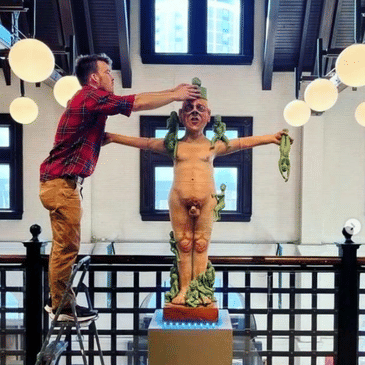
[00:36:18] I think that that one piece we were talking about on over email the shed self peace with all the green little figures everywhere.
[00:36:27] He was kind of like the first iteration of trying to.
[00:36:32] Merge some of those new media and new technologies where in.
[00:36:37] All the little green figures will disappear if you use a green screen filter.
[00:36:44] And I kind of that was kind of my my idea for.
[00:36:49] Yeah those little guys kind of they're almost kind of like little personifications of technology.
[00:36:57] That that are always kind of pestering us like our little phones or different gadgets and then.
[00:37:04] And making it difficult to be present and then when you use the filter or whatever they just they disappear the personifications but they're there.
[00:37:16] Very cool ideas.
[00:37:19] Yeah hey thanks so much for being with us here today I really appreciated the conversation.
[00:37:26] Yeah thanks Bob was nice chatting nice finally meeting you.
[00:37:31] Yeah absolutely it's been great thanks for your ideas I think that many of these will be awesome for our listeners and and urge them into different areas to experiment with.
[00:37:45] In their practice as well.
[00:37:48] Great and you know the inspiring for someone out there.
[00:37:53] Cool thanks a lot.
[00:37:55] We'll connect in the next little while sounds good.
[00:37:58] Okay bye bye have a great day Bob cheers.
[00:38:15] We'll see you next time.