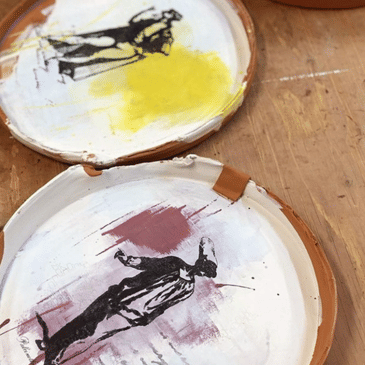
In today's episode, Bob Acton has a lovely conversation with Miche Follano where they discuss colour, slips, surface design and ideas about how to produce beautiful work.
Inspired by her love affair with collage, printing and painting, Miche's current body of work uses the urban landscapes to inspire a contemporary interpretation. The interplay between surface and form, the ways in which colours exist side by side provide infinite ways of how clay can be transformed into rich, visceral and personally expressive individual statements.
Intuitive mark making, lithography and clay manipulation, combined with careful deliberation on familiar form, provides a satisfying making process; allowing for the spontaneous to sit beside the considered. This builds an exciting visual language open to personal interpretation
[00:00:00] I'm a big fan of old slipwear which I find really charming more than anything actually
[00:00:08] and I like the idea of using clay that isn't precious I think is the word that I would use.
[00:00:17] I kind of like its raw edges, I like the feel of terracotta, I love it when you fire
[00:00:23] it super high and it goes a really beautiful rich sort of dark brown and then you've got
[00:00:29] this, it's very difficult to add color onto that surface so I started sort of introducing
[00:00:37] basically its slip.
[00:00:40] Hi I'm Bob Acton and welcome to the Color and Ceramics podcast.
[00:00:45] Today we're lucky to have Mish Philano on the show.
[00:00:48] As an outstanding potter in the United Kingdom who does beautiful work with slips and color
[00:00:54] and images on terracotta clay.
[00:00:57] We talked about her journey in clay, her surface design methods, how she engages her spirit
[00:01:04] in her work and some advice she has for potters.
[00:01:08] You'll find links to her website and social media in the show notes so let's get to
[00:01:13] the interview.
[00:01:21] Welcome to Color and Ceramics, the podcast for ceramic artists who want valuable ideas about
[00:01:26] using color from leading artists and world class experts.
[00:01:30] Here's your host Bob Acton, a sculptor and ceramic artist who's fascinated with color
[00:01:36] and help potters, sculptors and artists use color in their work.
[00:01:40] Her name is E talks with this guest about color, techniques and the impact of color on
[00:01:45] people and art itself.
[00:01:47] Well Mish thank you for joining me today and welcome to the Color and Ceramics podcast
[00:01:53] to talk about color and surface design.
[00:01:56] I really love your work.
[00:01:58] I love the beautiful ceramic pieces that you have with the sketching, the colorful sketching
[00:02:04] that you have on it and the white slip.
[00:02:07] I assume it's white slip that you have on the dark clay because I think that really
[00:02:12] makes things pop.
[00:02:16] So welcome to the podcast.
[00:02:18] Thank you very much, he makes nice to be here.
[00:02:20] Yeah absolutely.
[00:02:21] You know the beauty we see and feel when we approach your pieces really represents years
[00:02:28] of hard work and I wonder if you could tell us a little bit about your journey in becoming
[00:02:34] the artist you are today?
[00:02:37] There's rather a long journey that has been broken up into you know fair few pieces but
[00:02:43] it kind of started at school so back in the early 80s I left school and because there were
[00:02:51] no jobs I decided that I would take on a college course where I fell in love with clay more than
[00:03:00] anything.
[00:03:01] And that took me onto a foundation course which then took me on to do a degree and
[00:03:07] I did my degree in woods, metals, ceramics and plastics in Brighton UK.
[00:03:15] But that got sort of stopped short after two years because funding changed in the UK
[00:03:21] so a lot of people couldn't actually finish their degrees which and I was one of them
[00:03:27] but I still knew that that was something I was definitely going to pursue at some point
[00:03:32] in my life.
[00:03:34] Well to fast forward a few years I took a job working in a graphics department for a small
[00:03:41] company which when everything was very analog there was no computers it was all daisy
[00:03:47] wheel printers and bromide cameras and was very hands on that suited me really well.
[00:03:55] But unfortunately after about six years working there the owner was tragically killed so I
[00:04:03] kind of lost my job there and then I went to work for another company called Xart which
[00:04:11] we had this sort of mobile phone revolution happening and I was employed by they were
[00:04:17] a subsidiary of Nokia.
[00:04:19] And so my graphics got very grounded at that point and I was working for all the Premier
[00:04:27] League football clubs designing their mobile phone faces.
[00:04:30] I'm sure you remember the old 3210s and 7110s where you clips the fronts and backs on
[00:04:37] the phones.
[00:04:38] Well a lot of those I was responsible for on a home hands up so I got involved with graphics
[00:04:46] in quite a big way actually and I really enjoyed doing it although it was very too dimensional
[00:04:51] it was something that I think my love of print and my love of colour because obviously especially
[00:04:58] with Premier League clubs and formerly one racing and not particularly the things that I
[00:05:04] was interested in but I did like playing around with all the text and the badges and
[00:05:09] there was like your collage in constantly on two dimensions which I sort of loved.
[00:05:15] And then in 2008 I had the opportunity to go back to college and leave work and so I found
[00:05:22] a course where I could rekindle my love and clay really and I found a part time course
[00:05:32] that was doing a foundation degree.
[00:05:35] I went along there to get like a portfolio together and to sort of reinvest myself into
[00:05:42] that material but in the background there was all this stuff that I'd learnt from graphics
[00:05:48] and input you know was just going in and it was sort of coming out on the clay badly at
[00:05:53] that time I'll add but it was it was going in and out again and it was like okay this
[00:06:00] is this is something that I hadn't really considered but I really enjoyed trying to find ways
[00:06:07] of surfacing things which had multiple layers different colour combinations and also print
[00:06:17] which I really wanted to keep within the work.
[00:06:21] So I finished that two years and I went to St Martin's to finish my degree in Central London
[00:06:28] again learnt an awful lot at St Martin's fantastic course came out of there hit the road you
[00:06:36] know decided that's it I'm brilliant now I must be brilliant I'm just going to be able
[00:06:42] to do this forever but you kind of then lose the ability to use the facilities which I
[00:06:50] haven't really considered so where I was going in and making up screens to do print with
[00:06:56] all of a sudden I didn't have a screen printing option.
[00:07:00] So I started to sort of experiment with other ways of working on a surface in an analog
[00:07:07] kind of way which then took me onto a masters because I felt that I hadn't learnt everything
[00:07:16] I needed to learn so I went to the Royal College in 2014 and graduated in 2016 and I spent
[00:07:28] most of my two years there experimenting with print and surface.
[00:07:38] So that's sort of how I've come to this point so after I left there had a really good degree
[00:07:43] show got some great opportunities sort of continuing with those opportunities and it just
[00:07:49] snobles from there on and I'm still even now experimenting with colour and print and each
[00:07:57] week I try other things.
[00:08:00] So I'm always looking for ways to have that immediacy of working in a very immediate way so
[00:08:06] a little bit like when you're doing a two dimensional collage you kind of pull things from different
[00:08:12] places and add and take away it was very much like that so that's where my work really
[00:08:18] sits and that's the bit I enjoy the most really so that's sort of how I am where I am now.
[00:08:24] Very cool thanks so much for sharing that you know when I look at your work your clay work
[00:08:30] it really seems to be kind of as I mentioned earlier kind of a juxtaposition between this
[00:08:36] dark clay that you work with and then this smooth brightly coloured slips and colours
[00:08:43] and stuff can tell us a bit more about that process like how did you come up with that
[00:08:47] or what do you do with that?
[00:08:49] Well I'm a big fan of old slipwear which I find really charming more than anything actually
[00:08:57] and I like the idea of using clay that isn't precious I think is the word that I would
[00:09:05] use.
[00:09:06] I kind of like its raw edges I like the feel of terracotta I love it when you fire
[00:09:11] it super high and it goes a really beautiful rich sort of dark brown and then you've got
[00:09:18] this is so difficult to add colour onto that surface so I started sort of introducing
[00:09:26] basically it slip you know introducing slip onto terracotta and then colouring those
[00:09:32] slips creates this really vibrant I think a sort of juxtaposition I think of this very
[00:09:41] matte dirty surface with a super shiny glazed surface for me just always it reminds me of
[00:09:51] old buildings and when you're walking past the window it goes from dirty brick especially
[00:09:57] in London dirty brick into glass into dirty brick into glass and that sort of penetrates
[00:10:04] I think when you're living I don't live in the city but I've spent quite a lot of time
[00:10:09] there so you can't help that just filters in so for me having that complete opposite is
[00:10:21] quite exciting for me.
[00:10:23] I can see why how do you balance the use of colour with the other elements of design like
[00:10:30] form and texture and so on?
[00:10:33] I don't tend to use much texture I allow the clay to provide its own texture so sometimes
[00:10:40] I'll use a very groggy clay and sometimes it's a smooth clay I think it just depends on
[00:10:45] where I'm at at the moment sort of I'll switch between different clays and the colour is
[00:10:52] more about what I've seen yeah I'm a bit of a sort of flannery in that way and I'll
[00:10:58] sort of walk round streets wandering aimlessly and allow it to soak in and then I sort of
[00:11:05] come back and I avid sketchbooker I'm constantly drawing and painting a sketchbook and sketching
[00:11:13] in my sketchbook and so what I'll tend to do is I cut out a little window in a piece
[00:11:18] of cards and I kind of move it around the sketches that I've done and I'll sort of see
[00:11:25] different colours and it becomes more abstract and so it's rather than it being a drawing
[00:11:31] of something in particular it becomes a section of that drawing which I then kind of recreate
[00:11:37] onto the surfaces using those colours really.
[00:11:41] I will take a little bit of artistic licence and change things around a little bit ultimately
[00:11:49] I will like the way the colours are positioned or the way that the composition is working
[00:11:56] and then I transfer that.
[00:11:57] It's quite difficult on to 3D because you can't see moving the vessel around to sort
[00:12:03] of make sure it works on all those angles if that makes sense.
[00:12:07] Yeah it does and I think when I've seen your work it's a two-dimensional photograph so
[00:12:13] we're only seeing a portion of it are your colours all the way around the piece or just
[00:12:18] on one's okay.
[00:12:19] Yeah, they're all the way around.
[00:12:21] That's a very interesting thing as you were talking about cutting out a hole out of a piece
[00:12:28] of paper that makes me think of landscape artists who may pull that kind of a process
[00:12:33] up in the landscape to find that piece that they want to paint.
[00:12:37] Yeah and I think it does make it quite abstract in that sense so it's very difficult to explain
[00:12:45] if I've been to York or somewhere and someone says why is this York?
[00:12:51] That's a good question because when I go through the process and tell them the process
[00:12:58] they all get it and they can see maybe the colours will reflect what I've seen in that
[00:13:05] city or in certain parts of the city.
[00:13:08] Absolutely so you've taken a piece of your sketch of the place and that becomes the sketch
[00:13:15] as I might say it on the work itself.
[00:13:19] Absolutely.
[00:13:20] So you use some really bright colours which I of course I love those but I wonder if you
[00:13:25] could tell us about any challenges that you faced in working with colour, in ceramics
[00:13:31] and how you overcame those challenges?
[00:13:34] A lot of the time I'm looking for which depends I think colour can be sort of two things.
[00:13:41] The first is there's a very flat colour, almost like a gouache where there's you know
[00:13:47] aura if you're working in paint.
[00:13:49] It's a very flat one solid colour which can have you know under glazes will work like
[00:13:56] that but for me that sometimes it's not enough so and I've just actually finished a piece
[00:14:04] that's in greens which I find very difficult to work with green and yet there's probably
[00:14:11] about six different greens that make up the block of the colour.
[00:14:17] That took me a long time to break out of just this flat colour so that was about finding
[00:14:24] you know what I might do is I'll start with a base slip green and then I learnt quite
[00:14:32] quickly that you've got to be careful how much stain you add to slips because I sometimes
[00:14:38] were early on, I was getting a lot of bubbling and a lot of crawling and because I was just
[00:14:43] overloading it so much but I think over time you learn to understand your palette and understand
[00:14:53] how to mix those palettes.
[00:14:55] So some I know that I can only add up to 5% of something whereas another colour I might
[00:15:01] be able to add 15% so you kind of learn those things actually go along and it is about
[00:15:06] experimenting I do a lot of experimenting and the same when it comes to drawing over
[00:15:13] the top of those as well so I may get all the flat colours if I call them that the big
[00:15:19] block colours and then I'll put subtle colour on top and some of those subtle colours don't
[00:15:25] like other colours and that's just you know one of those things you learnt and it destroys
[00:15:32] you a little bit especially if you really like the piece and it comes off and it's crawled
[00:15:36] off or it's peeled off but you kind of work around it you know all those every time you
[00:15:42] have a problem you can sort of work around it and I started off from where you were before
[00:15:49] and then adapting what you've done so there is a lot of testing there are a lot of sometimes
[00:15:56] some mistakes because you can get a bit over zealous when you're working in such a fluid
[00:16:01] way you kind of forget that didn't work with that last time so you know I do have some
[00:16:07] howlers.
[00:16:09] It is a lot of practice though isn't it and I think that you know we I listen to people
[00:16:16] in other worlds like musicians and so on who you know advise people to practice deliberately
[00:16:23] and to practice deeply I was thinking of Anna Vittovec she was a classical guitar player
[00:16:30] and she said that we have to work on our technique all our life and you know and given
[00:16:35] that you're at the top of your artistic game how do you practice your we've kind of been
[00:16:42] acting on that a little bit how do you practice colour and surface design.
[00:16:47] What I tend to do is whenever I put a kiln load on I will always take some of the palette
[00:16:53] that I've got and then I will meticulously paint them over the top of each other in
[00:16:59] different ways I might paint an orange over a green or a green over an orange and I'll
[00:17:04] mark what I've done you know I'll mark those those test tiles if you like and I fire
[00:17:09] them in exactly the same way as the work that I'm firing at that time so every time I fire
[00:17:16] something I've always got something in there that I'm testing.
[00:17:20] So I'm for example I've made up a printing ink that is a little bit risque because it's
[00:17:30] made with oil and I you know that could throw everything out.
[00:17:38] So I'm sort of a bit careful now so I did a lot of tests on different things printed
[00:17:44] onto slip printed onto under glaze printed onto stains printed onto pretty much every
[00:17:50] permutation that I use to create those colours and then glaze them all and you sort of
[00:17:58] very quickly learn which you can do that with.
[00:18:02] So you know I can't for example print onto the top of a very highly stained slip because
[00:18:11] for some reason the oil base of the ink doesn't like the thick slip underneath and it
[00:18:18] will go a very mucky greeny sort of nasty colour but it won't you know it will also blister
[00:18:26] the glaze.
[00:18:27] So you kind of each time I've introduced something new I will test it methodically which
[00:18:36] we think a lot of professional potters do as a matter of course anyway because you spend
[00:18:43] a lot of time making objects and the last thing you want to do is just chance it you know
[00:18:48] and throw it in the bin when it comes out the kiln because that's happened a lot.
[00:18:52] Yeah me too me too.
[00:18:53] In fact that was one of the things that stimulated my desire to do this podcast was because
[00:19:00] often we make the form and then we've got to apply the finish to it and that can create
[00:19:05] lots of stress and anxiety about the whole thing and you know one of the things that crossed
[00:19:11] my mind as I was listening to you was how our customers or our audience often doesn't
[00:19:18] understand because they don't see it all of the hours and the hardache that goes into
[00:19:24] testing and trying and all of those things that you're talking about.
[00:19:30] Oh they know that's one of the questions if I'm doing a show you know public show then
[00:19:38] that is probably one of the things that people ask me the most how do you do that and
[00:19:45] it isn't so much as that.
[00:19:47] It's not just one thing you know there's probably seven or eight different processes involved
[00:19:54] in creating this surface so you know you can go online and you can find potters that love
[00:20:03] showing how they do stuff and they're not camera shy and they're quite happy to tell
[00:20:10] you what they do and I think all potters are very generous with their you know how they
[00:20:16] do things because I remember as a student I would be asking those questions as I was
[00:20:22] going around the show so most potters have been in that position and it's not just an
[00:20:28] art form it's a science as well so that science side crops up quite a lot and that's
[00:20:34] the bit when is all very well if you're working in 2D with paper and pencils you can easily
[00:20:40] rub things out and scribble them off but when you're working in 3D dimensions and it's having
[00:20:45] to go through like volcanic temperatures there's a lot of science there.
[00:20:51] Yep, yep, yep, okay.
[00:20:52] And you start explaining to people that by your work and they do have very appreciative
[00:20:57] of you giving the information they've you know very I tend to find that most people that
[00:21:02] talk to me really want to know it's not it's not sort of lip service they really are interested
[00:21:10] in how you do stuff and I think the more complicated things are the more interested they are too
[00:21:17] so I'm always forthcoming about how I do things.
[00:21:21] Cool, you know you've talked about you learning particularly around the chemistry and science
[00:21:27] of food play and ceramics I wonder if there are any specific artists either in the ceramics world
[00:21:34] or other artistic disciplines whose use of color has really had a profound impact on your work
[00:21:42] that they've been.
[00:21:43] One artist in particular that I really admired you know when I first started using color was
[00:21:50] I don't know if you've heard of Laura Maybury, she's an American artist.
[00:21:56] And I've watched her sort of career and her new you know as her work evolves
[00:22:02] and I do sit in awe of her work because she's also you know not just block color now everything
[00:22:09] the colors moving and you know some of the work that she produces now like sculptural pieces where
[00:22:17] the clay is actually the sculpture and the glaze becomes this part of this great sculpture.
[00:22:24] So I do look at her work and also the scale of her work sometimes can be really impressive
[00:22:31] and I'd love to work on that scale I just don't have the room to work on that scale
[00:22:36] you know everyone's sort of a bit bound by what space they've got you know I'm bound by what
[00:22:42] kilns I've got so I can only work to a certain scale but her work in particular has really kind of
[00:22:51] really has profoundly affected me but the other person as well is Picasso
[00:22:56] bizarrely Picasso's ceramic work is outstanding.
[00:23:04] I was really fortunate when I was at the RCA to have I think it was Christie's the auction house
[00:23:14] came to the RCA and wanted to photograph the work of Picasso that they'd got for auction in our studios
[00:23:25] and so I was really fortunate to be able to see these things and handle them you know close up
[00:23:32] and they are so simple and beautiful and the line making and the mark making is spectacular
[00:23:40] and probably some of the most simplest things that I've ever seen but the most effective
[00:23:48] so sometimes I do feel like I just want to do one line and that's it and that is something that I
[00:23:56] I'm sort of I'm getting better at now pulling back a little bit because I can sometimes
[00:24:04] bit to exuberant and I do you know I do know that. Yeah it sounds like you're seeing doing less
[00:24:12] is sometimes more. I think the quality of the line is super important
[00:24:19] and you know it's it's about that expression that you get in just one brush mark or two brush marks
[00:24:28] a bit like Cytwombly as well whose color palette amazing paintings so I think I'm probably more inspired by
[00:24:35] painters and you know some of the St. Ives group and I particularly like some of their landscape work
[00:24:45] and Patrick Heron so I think most of the work that I really admire their use of color was probably
[00:24:55] the abstract expressionist periods where they were using block color but somehow the line quality
[00:25:03] was exceptional for me. It was exceptional yeah. Yeah that really makes it pop doesn't it?
[00:25:10] the you know you can have that as you call it that flat color surface but the line that you might
[00:25:17] put in the piece really draws the eye to it. It does and again when you're working with clay
[00:25:25] it's much more difficult to create those lines. I see kind of find you end up with certain tools
[00:25:32] that you've found or you've worked with for example I use a porky pine quell quite a lot
[00:25:39] to draw those lines because it's slightly bendy and I tend to do I'm right handed but I tend to
[00:25:46] make the marks from a left hand so I'm a little bit more out of control and the lines create
[00:25:51] themselves then so I'm not controlling it you know which can be really really interesting when
[00:25:58] that happens. You do get some marks that you go I could never have done that because I think the
[00:26:05] pressure's too much when you're trying to create this certain line so if you take the pressure away
[00:26:11] close your eyes or do it with your left hand you always get something much more exciting.
[00:26:17] Yeah for sure for sure I agree completely I was thinking about in my world sometimes if I'm using
[00:26:23] my right hand I'll get what I call tight and I don't want to be tight so that I really relate
[00:26:29] to what you're talking. Yeah and I do that quite a lot actually actually I'd say more so because
[00:26:36] I can draw very you know normally like an artist can draw but I don't particularly like those
[00:26:43] drawings the ones I like the most are my sketches the ones that I haven't had that pressure's
[00:26:48] moment with they're they're very loose they're very free and they're more me I think
[00:26:55] that sub-conscious side of you that just comes out when you're not really looking or concentrating
[00:27:01] they're the ones I like the most. Yeah very cool the spirit comes out in that way. I think so.
[00:27:06] Yeah very cool hey you know I was thinking but we've talked a lot here today already about
[00:27:13] your technique and how you do things and how you approach your work and I wonder what advice
[00:27:19] you might have for a young ceramic artist or maybe an older one who's starting out but some
[00:27:27] what advice have you got for a budding ceramic artist will call it that who's just starting to
[00:27:32] develop their own unique style. I think one of my tutors once said to me that it was important
[00:27:41] that I was having fun and I never really thought about that very much until I started making for myself
[00:27:52] properly for myself as an artist and you have to have fun while you're doing it because I think
[00:28:00] it becomes a job otherwise and I don't really want a job if that's something well that makes
[00:28:07] me sound like but I know exactly what I mean. I kind of love doing what I'm doing and the freedom
[00:28:14] of doing it and I mean from a psychological point of view when I come into my studio and I shut
[00:28:22] the door and I switch on the heater and I put my radio on I'm in my own space I mean my head
[00:28:29] goes into you know the space I need it to go in it just does and the worrying side of my brain
[00:28:37] and the daily side of my brain just switches off and then and then the other side of my brain I
[00:28:42] think just switches on and concentrates on what I'm doing and so I don't get bogged down by everyday
[00:28:49] stuff. So if you're a ceramicist or you want to be ceramicist or just a hobby potter or
[00:28:59] you know working with clay I think there's an innate knowledge that happens when you pick up clay
[00:29:08] it just is there it's born with you there's a sense that you get when you work with it
[00:29:15] and it unlocks a part of your brain and it gives you rather side of the brain of rest so any potter
[00:29:22] that's out there thinking it's not for me even if they just play with a ball of clay I think that's
[00:29:29] beneficial to their mental state as well I just think it's the best thing for them to do keep picking
[00:29:37] up the clay keep making and allowing yourself to keep making and allowing yourself to keep making
[00:29:41] mistakes because you will find what it is you're looking for at some point and it's great fun when
[00:29:48] you do it's like revelation me yeah and it's really a balance I think between knowing the
[00:29:55] technical side enough so that it works like you're talking about what temperature do I put it out
[00:30:02] and and what how much stain do I put in this I'll call it kind of the technical piece
[00:30:09] with this freedom that you're talking about this this this joy this sense of allowing the spirit
[00:30:16] to come out and it's about allowing balls to happen at the same time ultimately yeah I think so
[00:30:26] when I've done run classes in the past I have people from all walks of life in their classes
[00:30:33] and you know from nurses to teachers to pretty much any retired right across the board I mean
[00:30:41] I've got a year down 18 year old and they sort of come to you with their daily troubles
[00:30:49] and by the time they've left three hours later you can see that spirit has been allowed
[00:30:55] to come alive in the classroom and they will sit and make and some will sit very quietly and
[00:31:02] they're happy in their little making zone and others create this they've got an aura about them
[00:31:08] where it's excitement and as a tutor that is something that really excites me and they come to me
[00:31:17] for the technical advice so the technical advice can be learned by books and you know I think everybody
[00:31:26] can learn that technical side um me personally I was the pain in the backside for all the technicians
[00:31:34] at the university is because I just followed them around like what are you doing how are you loading
[00:31:39] that down what temperatures that you know and I think I drive them a little bit nuts to be fair but
[00:31:46] all that knowledge goes in and now I'm giving that knowledge out to the students so you can
[00:31:52] learn it out of a book but not it's much better when you practice practice it I think yeah very
[00:31:59] and by those mistakes yeah absolutely I you know we'll put a notification of your website and so on
[00:32:07] up in the podcast but I guess I'd given you what you just said some people might say hey does she
[00:32:13] teach and can I go and take classes with her so that's my question do you teach can people come
[00:32:19] and take classes with you I did up until about two years ago I was running classes from my studio and
[00:32:25] um I was keeping people's sain during COVID when we were allowed to mingle so I basically opened up
[00:32:32] the class for three at a time and said that they could socially distance and for them meant to have
[00:32:39] a lot more than anything um and I taught those for quite some time and I gave them basically
[00:32:48] I had to stop the teaching about I think just over a year ago now because I got too busy and
[00:32:56] I was you know um running out of kiln space not getting any of my work done and so it became
[00:33:04] a point where I was at a balancing point and I was like my work's being affected now so I have
[00:33:11] to like put that on hold so I mean I'm doing a talk demonstration talk and about three weeks time
[00:33:20] where I do demonstrate some of the processes that I use and talk about my work and that's in
[00:33:27] place in England called St Orbans at the decorum and Chutton Potter's group so we have quite a lot
[00:33:33] of those groups in England scattered sort of over the country so I'll very often go and do one of
[00:33:38] those for them so that those people that know me that want to learn how to you know do the work can
[00:33:45] actually go to those those demonstrations so at the moment I am not teaching. Okay so nobody call
[00:33:55] you except look out for your workshops because you might be putting on a workshop nearby. Well it's
[00:34:01] more like a sort of talk so you sort of do a talk demonstration really so I sort of talk about
[00:34:10] some of the you know I'll take my sketchbooks along and I take how I get inspired, how I work out
[00:34:17] what I'm going to do on to a vessel and then I'll show them some of the techniques on a half-built
[00:34:21] vessel so they can sort of see how to do them at what stage you add slip to the pot or how you would
[00:34:32] paint onto some newspaper and use that like a carbon paper and you know using sort of stencil
[00:34:39] techniques so I kind of go through that for about an hour with them as well so they sort of go away
[00:34:45] going oh I'm gonna try that which you know I've done my job if people go away thinking that so yeah
[00:34:52] Well I think people are gonna go away from listening to you speak today on our podcast
[00:34:58] really excited about some of the work that you're doing and I want to just say a big thank you for
[00:35:04] participating here today it's been wonderful meeting you and learning more about your work and
[00:35:11] how you think and how you let your spirit out so that's pretty cool. So thank you Bob it was
[00:35:18] a pleasure to be here thank you very much good luck with the rest of your podcasts thanks so much
[00:35:25] Thanks for listening to the color and ceramics podcast with Bob Acton and his guests please help
[00:35:31] others find the podcast by subscribing to this podcast wherever you find your podcasts such as iTunes
[00:35:37] Spotify Amazon Music YouTube or other pod catchers and don't forget to give us a review we'll see you
[00:35:44] next time