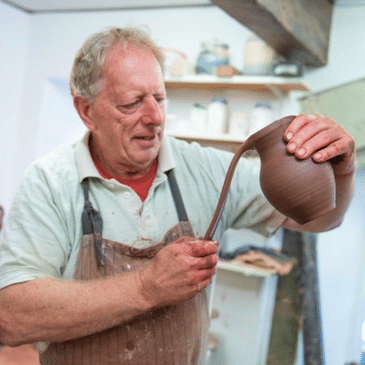
Welcome to the Colour and Ceramics Podcast and Bob's interview with Richard Wilson. Bob and Richard talk about his journey in clay and his approach to colour and surface design.
Richard was born and brought up in Norwich, and has been making pots since the early 1970s. After studying for two years at Great Yarmouth College of Art, he worked from 1974 to 1980 at Le Dieu Pottery in Norwich before spending 3 years in Australia and New Zealand, and a further five in Germany, working with many potters using different techniques, in particular woodfired salt glazes.
He now uses brightly coloured slips on his work. You can find him on his website at https://www.rwilson-ceramics.co.uk and on Instagram at https://www.instagram.com/richard_wilson_ceramics/
[00:00:00] I sometimes have been using a very thin brush, like a pencil brush. Then I can use the colour
[00:00:07] meat sometimes and just flick around with it just on the surface so you get two or three variations
[00:00:15] of colour just within the same sort of batch. Hi, I'm Bob Acton and I'm happy to share my conversation
[00:00:24] with Richard Wilson, a potter in England who does just fantastic work with bright and vivid colors
[00:00:31] on his pots. He and I talk about his journey to his current style, how he approaches his use of
[00:00:38] coloured slips and his ideas for ceramic artists wanting to explore more colour in their surface design.
[00:00:46] You can check Richard's work on his website and Instagram page which you'll find referenced
[00:00:51] on the show notes. Welcome to Colour and Ceramics, the podcast for ceramic artists who want valuable
[00:01:04] ideas about using colour from leading artists and world-class experts. Here's your host, Bob
[00:01:10] Acton, a sculptor and ceramic artist who's fascinated with colour and how potters, sculptors and
[00:01:16] artists use colour in their work. Tune in as he talks with his guests about colour, techniques and
[00:01:22] the impact of colour on people and art itself. Welcome to the Colour and Ceramics podcast, Richard,
[00:01:30] really glad that you're here. You know I really love your work, I am really fascinated with the
[00:01:37] colour and the intensity and the boldness that that your work really portrays so I really appreciate
[00:01:43] you being here to talk a bit about that. I wonder if you could tell us a little bit about you
[00:01:49] in your work and when you started in Ceramics, how it evolved for you, those kind of things.
[00:01:56] Sure okay well my background is really coming out of our college for maybe two-year course which
[00:02:07] wasn't that sort of focus on Ceramics but it was a multimedia course. But then at the end of it
[00:02:12] I sort of focused on Ceramics as being my major sort of interest, I thought being practical,
[00:02:18] I thought I could actually make a living out of making things, you know, maybe fine art was
[00:02:26] a bit sort of out there and not really kind of able to sort of market it in the same way.
[00:02:32] Anyway so that was the focus I think but fortunately I was never together an apprenticeship with a
[00:02:39] local potter in Norwich which was in east of England. So I really worked with him for about four
[00:02:47] years, maybe five years as an apprentice man from there. I kind of met with other people,
[00:02:56] I was at a workshop that had a lot of transient potters coming through it for a short time. There
[00:03:02] was a New Zealand potter at the time and a bit later on there was another English potter who would
[00:03:09] actually set up his workshop in Tasmania. And so I sort of got to know these other potters and after
[00:03:19] about five years I said this was in the late 70s so I still had sort of my youth on my side to
[00:03:26] sort of go off and explore the world. So that was my kind of an emphasis of wanting to get out and do it.
[00:03:35] So I went to Australia and New Zealand for two or three years and worked with these guys
[00:03:44] and through that I was able to kind of build my apprenticeship.
[00:03:49] Oh very cool because it was very much kind of working with people.
[00:03:56] I've called them to apply an ear sort of making a studio, building a workshop, finding local
[00:04:04] clays, making glazes, sourcing wood from local suppliers and then sort of just actually constructing
[00:04:16] a workshop around local materials. I mean in some areas of Australia New Zealand it's not that
[00:04:24] easy to get stuff you know you don't go down to the local ceramic suppliers. There isn't one
[00:04:33] there. They have to import it in a law way or drive a long way to get it which you do that scene.
[00:04:42] So yeah so I learned a lot by just being with these potters and three and then I came back to
[00:04:49] Europe and wanted to spend more time exploring the European history of ceramics and I kind of
[00:04:58] had this idea of wanting to delve back into the wood fire, the salt glaze style of central France.
[00:05:09] The area of central France have a really interesting style of making pots and make these big
[00:05:17] kilns that were sort of three draft kilns but they were very basic and they used to build these
[00:05:26] things and made pots that had lids on them were flat which were then the shells for the next pot
[00:05:32] so they built. They didn't have shells as such, they just cooked pots on top of pots and so
[00:05:40] that was a style that was sort of very familiar with that part of France and I love that because
[00:05:45] I knew at potter who was working in that area so I spent some time with him and so that sort of gave
[00:05:52] me a leap into Europe so I spent some more time. I had an opportunity to actually go to Germany
[00:06:02] to work with a German potter and actually ended up working with him for about five years
[00:06:08] so from that that was making salt glaze domestic ware in this big kiln, over 100 cubic foot kiln
[00:06:19] wood fired kiln and we just made lots of domestic ware and it was quite fun because there
[00:06:24] was lots of us in the workshop at the Bay of Divas and we used to sell on the markets every week.
[00:06:32] We used to go to local town markets and some of them were a lot further away but that was just
[00:06:40] the way it was over there and you kind of got to know lots of people.
[00:06:45] Yeah, sounds like that.
[00:06:48] Yeah it sounds like that not only did you get the experience of building a studio from the ground up
[00:06:55] as you did in New Zealand but also started to really touch on people from around the world and
[00:07:02] build those relationships with other potters. That's right because I think that's something
[00:07:07] important with I think it's one of those things with ceramics you can take it anywhere in the world.
[00:07:13] You might not speak the language but you speak the craft and you can actually go into a workshop
[00:07:19] and I'll say, can I make a pop and know what I understand what to talk about.
[00:07:26] There are some workshops that I find it quite difficult. I think you can
[00:07:30] went to some parts of India who had ever very sort of simple momentum wheel and thrown up a hump
[00:07:38] and that would be more challenging. Yes, I think that would be challenging. I've seen some people
[00:07:43] in Asia who sit on the ground and work a pot and so I think wow that would certainly be a challenge.
[00:07:50] So I was really interested in kind of the evolution of your work and as I said at the beginning,
[00:07:58] I love your bright, strong colors that you're using but you've also now talked about working
[00:08:04] in a salt kiln and working in France and was your work always this colorful?
[00:08:11] No, no it was very much working with I thought that I was a thrower. I was trained as a thrower
[00:08:20] in the workshop in knowledge so I never actually got to do any decorating. It was always the
[00:08:26] else that's off to do the decorator but I was all observed and towards the end I suppose at
[00:08:31] the time there I did it a little bit but it was very kind of a design that was repetitive you know
[00:08:38] you kind of it was a steady floral kind of idea that you put on a pot and it was
[00:08:45] I suppose that was there kind of seen their development and they had to kind of a repeat pattern
[00:08:52] that went around the pot and they were kind of okay but it was a bit boring. Yeah, that was already
[00:09:00] there popped into my mind when you said that. Yeah, yeah. And then I wanted to just get out and
[00:09:07] see what other potters were doing and different techniques because if you just brought up in one
[00:09:12] workshop and one style of work you miss out on so many areas of ceramics. I mean from like earth
[00:09:20] and wear right through to porcelain there's so many kind of variables and I'm a bit of a magpine
[00:09:26] aspect. I like picking up on ideas. Yeah, yeah. I like the sort of things that I still do.
[00:09:33] I still like to sort of pick and choose a bit so I'll try this and try that. So I guess that idea of
[00:09:41] wanting to sort of develop my style came out of having all these ideas. For the end of my head
[00:09:48] but when I was in Germany particularly that was when I picked up on another style of design
[00:09:55] because I went to Eastern Europe at the time. This is before the Berlin Wall and the communist
[00:10:03] blocks sort of collapse and it was more difficult to get into Hungary and Romania but I'm
[00:10:10] there with a potter I worked with an English chap in this workshop in Germany and he'd been
[00:10:16] over to Hungary quite a few times and he'd poke around in these old markets and places and he
[00:10:22] found some lovely old pots and dishes that were decorated in a very traditional Hungarian way
[00:10:30] and slip design. Yeah, that was that tradition as well.
[00:10:37] A floral tradition picking up on stories around villages you know they were like
[00:10:45] people getting married and celebration plates and things like that and scenes of things like that
[00:10:53] of birds and animals and things like that so they used to slip decorate bowls and chugs and
[00:11:01] things like that. I just loved the simplicity of that and slip design was something I hadn't really
[00:11:09] thought about too much so that was something that inspired me really and there was an English girl
[00:11:16] in this workshop in Germany that was doing a little bit of slipwear on stoneware pots. She used to
[00:11:24] make some lovely fish and bird designs on these pots but for herself it wasn't necessarily a part
[00:11:33] of the production but she just did it for herself. I loved the way she was decorating so that idea
[00:11:41] of the slipwear with a slip trailer sort of got me thinking and when I came back to England
[00:11:49] that was ready when I had to sort of pull all these things together and think,
[00:11:52] what would I do? You know, good good and salt glaze root or the stoneware root or go down the
[00:12:00] bathroom where root so it was finding a place where I could actually define what I do and that
[00:12:08] took several years, I mean I'm not saying that was sort of like overnight you know it's not an
[00:12:14] any evolutionary thing. So yeah I had that thing in my head thinking no this is where I want to go
[00:12:21] to it's finding the right techniques to achieve it. It's a lot of experimentation isn't it?
[00:12:28] I think you know you got to at least in my experience I have to try something I have like you
[00:12:35] a million ideas, a million things interest me but I've got to pull out something and then experiment
[00:12:41] with it. Is that what happened with you over the years of experimentation? Yeah yeah I mean there's
[00:12:46] a lot of things that I thought well I've got another idea and I'm not quite sure where that works so
[00:12:53] you come out to play with it. I think playing is an essence of what we do and we don't enjoy
[00:13:02] play in ceramics then you kind of losing the heart of it. Yeah absolutely. Yeah otherwise it becomes
[00:13:11] kind of too structured and too kind of formulaic, you know I think what I do is particularly is
[00:13:19] what lose that. In fact I want to lose more loose in that sense. Yeah well you've got to have
[00:13:28] it seems like your work has a lot of energy to it and it's almost like that energy is embedded
[00:13:35] in the pot itself and and that's what I hear you saying around play too that that plays got to
[00:13:42] have that positive energy to it. Yeah well I started off from making pots that were well defined in
[00:13:50] the sense that they were functional and then they had a strong form. Yeah quite simple I go
[00:13:58] like pots that are too embellished with other things you know no some potters don't make any
[00:14:06] handles on their pots to that reason and they decorate and that becomes as kind of an embellishment.
[00:14:14] When I suppose I incorporate a bit of both you know I do things that have function yet become
[00:14:22] one-off sort of work of art. I call it art on the table for that reason. Yeah absolutely.
[00:14:29] Yeah yeah. Now how did you learn about color and design? Like you watched other people were there
[00:14:39] other things that you learned like resources or books you went to or something that helped you
[00:14:45] refine that that focus. Not really I don't think I'll actually I think it's this idea of having
[00:14:59] subliminal ideas over the years you kind of pick up on these things I mean I'm very interested
[00:15:05] in fabric design and real paper design and just interiors and I suppose strongest
[00:15:16] influence is proper for color. But anyway it's this impressionist artist you know
[00:15:23] you know I'm my name and Suzanne and all those sort of painters that understood color.
[00:15:31] So I loved that because they were kind of they picked up on light and shade and spontaneity
[00:15:40] you know they worked outside so they weren't sort of in a studio all the time sort of cocking
[00:15:46] photographs or whatever. They're out there in the office and I quite like that idea of decorating
[00:15:53] I was like B.D. Quite direct. So I was making pots that I could decorate straight onto the surface
[00:16:02] so I don't bisque where and decorate I decorate on dryware. Oh okay and then fire once
[00:16:10] well I could do it's just because of the nature of how I work I bisque fire anyway
[00:16:17] okay because I can the glaze seems to fit better. Yeah yeah yeah. I mean where's something is
[00:16:25] I want fire things that I can get away with. I mean things like cheap pots I do
[00:16:33] cheap pots that I've got lots of I call them little sculptures. Little things going on and then
[00:16:40] you know teapots with feet yeah right so yeah and I quite like to have to bisque fire them because
[00:16:50] there's a little crack or a little thing that hasn't worked out. You know I can fix it.
[00:16:56] Yeah yeah yeah. So we'll talk about your technique in a minute because it sounds like you're
[00:17:04] using a slipwear is it you do you slip or under glazes just slipwear right? Just color plates.
[00:17:11] Yeah how does your selection of the color affect the mood of the piece or the impact on the person
[00:17:22] who's got the piece in their hand or using it? I think that's quite difficult to sort of
[00:17:33] answers sort of easily because it's very stuffy. I have a sort of balance of ideas
[00:17:42] the design has to work with the shape of the pot so I started off really making designs that
[00:17:51] filled the shape of the pot. I didn't want to just end up in a design that just fitted within
[00:18:00] the shape like if you were making a dish and you just decorated the central part of it you know
[00:18:09] I wanted a design that just went right through to the edge. Yeah yeah that's it but it's knowing
[00:18:16] how to do that without making it look as if it's fallen off. Yeah no exactly what you mean yeah
[00:18:24] so I picked shapes of pots and built the design that complemented it now so wherever it was a curve
[00:18:34] then I started off with the curve in the design so it kind of echoed the shape of the pot
[00:18:42] there was a design that looks like something of the shape in there or if it's as straight
[00:18:50] sided like a mug or a vase or something that's got straight sides then I can actually be a bit more
[00:19:00] angular about it and then using straight lines and I think I'm working more towards that
[00:19:08] because it's I suppose it's more the letting the pot dictate the design rather than the other
[00:19:18] way around and what I kind of like the idea of them working together. I don't want them sort of
[00:19:25] should be sort of fighting against each other you know yeah the pot then the design has to be a
[00:19:34] kind of a complementary thing. So it's yeah it sounds like that what you then use is your brush strokes
[00:19:41] need to match the form itself. Yeah yeah so I start off with darker colors as a sort of an entry point
[00:19:53] of the design and that kind of lays it down quite heavily but then I sort of overplay it over
[00:20:02] design it with other patterns that kind of complement the design like I feel is the black
[00:20:09] then I complement that with red and black and red work quite well together. If I start off with a
[00:20:15] dark blue then I often go with a lighter blue or green because those colors work well together
[00:20:23] so it's understanding what colors work together and when they're sitting together
[00:20:28] um do they complement each other? Some colors that don't work so well um think well I suppose if it was
[00:20:37] a this time yeah I suppose red and green kind of work quite well together. Yeah yeah yeah
[00:20:44] a lot's because we're doing this interview around Christmas right so that's what you think it
[00:20:48] of yeah for sure. Yeah um some colors are fine we won't get it. I think um what I
[00:20:58] mentioned in our range bangs into a blue or something it. Sometimes a bit of a clash but it's um I
[00:21:09] don't know it's it's hard to sort of get it right always and um and I don't always think about it
[00:21:17] I kind of idea of this is the palette of colors that I'm working with let's try these two together
[00:21:24] see what happens and it's thinking of colors and patterns together and you know I find
[00:21:32] to have to get into the rhythm and the flow of it um and that's why I often decorate on small pieces
[00:21:41] like mugs or something. I have lots of them great so it really kind of loosens up my design work
[00:21:49] hmm after about 20 mugs you know I can sort of feel relaxed and after then move on to repeat it.
[00:21:58] Oh that's really interesting so rather than doing just one big piece and leaving it
[00:22:03] you have a process it sounds like where you you get into a flow and you do that with some smaller
[00:22:09] pieces like mugs and you do multiple ones using the same palette and then that worked you up to a
[00:22:16] bigger piece that's awaiting you um you know when you're ready yeah because I use a smaller pieces
[00:22:25] as trials yeah little expense and leaving gaps and playing around with the patterns and thinking oh
[00:22:33] I haven't tried that bit before or it you know it doesn't matter so much on a small piece
[00:22:37] I get away with it yes but then after a while I think oh I'll remember that and and use that
[00:22:45] on a bigger piece. Very cool and do you set your palette out your selection of slips I guess
[00:22:53] that you've got in your buckets are they always the same colors you have in front of you when
[00:22:58] you start your your coloring process or do you pre-select them? Yeah well I have yeah I have about eight
[00:23:06] colors I work with and often I used to be very kind of precise about it you know like mixing
[00:23:18] I don't know 25% of color to 75% of of Swiss you know that was kind of just the sort of mix
[00:23:28] because I didn't want the color to fall off you know P last but that has to be a
[00:23:33] portion clay in the mix so I thought oh this is a that should work and then after one I thought
[00:23:42] oh I don't really need to work it out I have to percentage wise I just use as a color match you know
[00:23:48] so I just I get my colors often from a supplier that have strong colors anyway so it's about
[00:23:57] about half a dozen I guess good colors that I use from a supplier and within that I can get two
[00:24:08] or three variations of it just using stronger or less of it in the mix and often I just
[00:24:17] I sometimes if I'm using a very thin brush like a pencil brush then I can use the color
[00:24:25] neat sometimes and just sort of flick around with it just on the surface so you get two or three
[00:24:32] variations of color just within the same um um sort of batch of yeah like a blue or green or red
[00:24:43] yeah I can go from almost pink through to poppy red yeah so depending on the saturation
[00:24:49] of the of the pick in the slip so how I mix it up you know something I'm not I'm sort of less careful
[00:24:56] these days about how I mix it up so I can be quite messy so there's sort of things going on
[00:25:04] on my decorating bench with sort of sponges and bits of um slip trailers and think like so often
[00:25:13] I kind of mix one brush with the other yeah yeah sometimes you sort of a double mix and you get sort
[00:25:19] of two colors on the brush you know that kind of kind of works quite nicely sometimes so it sounds
[00:25:25] sounds like that you're not really rigid about that you're not cleaning your brush and making sure
[00:25:31] that it's exactly this color you're you're in a much more flow state I might think about sort of
[00:25:38] being spontaneous about moving that color onto the piece yeah well I suppose I've looked at artists
[00:25:46] yeah they work and they have seem to have more paint on the floor and they don't have
[00:25:54] yeah yeah um whereas some painters can be very kind of precise you know and they have everything
[00:26:03] lined up on the wall they all the brushes lined up and then all I find yeah just loosen up
[00:26:13] it's a well I guess that's just personality right and style about how you you're more of a
[00:26:19] loose guy and and that really works for you and because I think that's what you said all along is
[00:26:24] that I want this energy I want this spontaneity I want this energy attached to my pieces and
[00:26:32] it would be pretty hard to do that if you are super precise about about the application I guess
[00:26:40] of the slip yeah well I appreciate the the crossmanship of being precise because there's a
[00:26:48] a controller that I've kind of moved away from um I suppose because I've done it in the past
[00:26:56] I think yeah well I want to do something different that um I'm just going to see how do you get
[00:27:03] the sort of the more relaxed you get about certain things yeah yeah I think so but when I look at
[00:27:09] your forms though I see a lot of precision in the form itself so you're being very precise about
[00:27:16] how you make your teapots and bowls and forms and vases and so on as opposed to the free flowing nature
[00:27:26] of the color application yeah I'm kind of thinking I should maybe look at the forms in a similar
[00:27:36] way as I do the decorating um so some of the pots been making lately I've been a bit looser you know
[00:27:44] though I sort of add things to them in terms of slip for the more texture on the surface yeah I know
[00:27:52] you know if you go too much that way then there's too much going on you know it's like what
[00:27:58] we're trying to say you know yeah yeah sure you you sort of throwing the bucket absolutely absolutely
[00:28:07] so if you could if we could switch for a second and because you've talked very eloquently about your
[00:28:13] style and how you've learned it and what would you suggest for a young ceramic artist what would
[00:28:21] what advice might you give them about developing their unique style um I think it's very important to
[00:28:34] sit and watch other craftsmen and get involved in it in an apprenticeship or at least
[00:28:42] being able to work with other potters because I've I've met a lot of crafts people that have
[00:28:48] come out in college and they don't know a lot about the actual material that they're working with
[00:28:55] they don't understand clay they don't understand glazes um killings tend to be
[00:29:03] clogged in put on the the timer and let the kill them do the work um whereas
[00:29:11] I think if you kind of in an environment where you have to do things from the bottom up then you
[00:29:19] really understand how to overcome mistakes so what things gone wrong you know why glazes don't
[00:29:28] work or why that firing doesn't work you know they're sort of understanding the chemistry and the
[00:29:36] physics yeah what goes on it yeah but clay I make a lot of sense I I know with I used to do a lot
[00:29:43] of woodworking and and in lots of ways I found it fairly simple compared to clay because it's so
[00:29:50] complex and there's so many things that can go wrong you do really need to have that depth of
[00:29:55] understanding so I I hear what you're saying there yeah well it's so important to have the right
[00:30:03] teacher as well to guide you through otherwise you you flounder around I mean I know one
[00:30:12] two young potters that stick to what they've been trained to do I suppose at college so they've
[00:30:21] worked with either white porcelain or white white earth away which is like porcelain um all they're
[00:30:29] they just love to do the other direction they go often work with someone help them
[00:30:37] fire wood kiln for a week you know do that sort of thing so that's that's probably the best way
[00:30:44] to learn being in an environment where you're meeting and working with other potters yeah but I
[00:30:52] travel is another great way to um discover things um especially in parts of Europe they're still
[00:31:01] making some fantastic pots in very traditional ways um there's lots of good workshops out there
[00:31:09] that we love to have a younger apprentices for a short while so so traveling which was really key
[00:31:16] for you I think as I've heard you talk about all over the world connecting with people seeing how
[00:31:23] they did their work helped you really come up with what you love to do today and I can see why that
[00:31:30] would be a really helpful thing for people to do to learn their craft well yeah because it is a
[00:31:39] worldwide craft you know you can go from southern south america right through to um it's easier
[00:31:52] like that we're you know all making pots you know been doing for thousands of years yeah absolutely
[00:31:59] I was I was just in turkey and so had an opportunity to see some of the work there
[00:32:05] and and it's really good to see the different cultural aspects of things and how they work with
[00:32:10] things uh I know I had a teacher of mine who was from Romania and so he brought a different angle to
[00:32:17] the conversation which was really helpful did you find that um uh you understood the sort
[00:32:26] of the cultural background to as well because all these styles come from functionality you know they
[00:32:33] they built um either they're killed in the round of the pots or they built the pots around how
[00:32:40] they were used you know they were made for particularly used in the kitchen yeah and then
[00:32:46] putting food in and think about that so yeah that was the way they were designed you know
[00:32:52] beautiful pots we bought they were built for a reason yeah really based that design
[00:33:00] yeah for sure really based in the functional uh aspect of things for sure right that was
[00:33:05] really I think the history of of pots and pottery was really uh in that in that specific realm
[00:33:13] um can you tell us about a challenge that you had in your work you know
[00:33:20] a problem that you had or an area where you struggled and how you overcame that
[00:33:29] um I suppose it's it's taking your designs or your techniques to certain limits
[00:33:40] of um a rational design so I'm thinking of my platform pots that I do which are basically
[00:33:50] look like pots but they're very narrow they're built only about sort of
[00:33:56] four inches wide I suppose at the at the base but they could be um overfoot thick you know wide
[00:34:10] they're spurs and always like silhouettes or shadow pots that's for sure yeah but I designed them
[00:34:18] really for two reasons um because I moved the workshop and I decommissioned this a big kill
[00:34:24] in my head and so I moved a smaller kiln which I could transport quite easily and um
[00:34:32] when I set up again I wanted to make big-ish pots in a small kiln so I thought
[00:34:40] making them flat sort of sought that one out yeah um I had this slab roller given to me
[00:34:49] and uh so I wanted to experiment with that really and it made me some slab pots
[00:34:57] so that's kind of where problem started was sort of having the right sort of a clay
[00:35:03] for that technique because once you start making big pots sort of flat um then the stress
[00:35:12] tension across the surface area um in a kiln you know the shrinkages and the tensions that go on
[00:35:19] in the firing um so I used to lose a lot by tracking that went on so and that was to do with
[00:35:28] be the firing them too fast or um just making sure I had the right um type of clay for that
[00:35:36] sort of a shape then also the size of a good when over at certain width then I started out
[00:35:43] problems but so I kind of rained them in a bit so I'm making them a bite I suppose about um
[00:35:50] oh I mean the same measure I suppose there about 40 centimeters wide um
[00:36:03] about 50 high and then I'm looking at 10 centimeters wide at the base
[00:36:11] um but the actual pot can be less than that you know could be like a or nine
[00:36:19] in in actual width floorways at the top but they have a base to make it more stable
[00:36:26] so it's just just making pots like that create problems um it sounds like you
[00:36:33] solve that problem by experimenting with different sizes different clays different temperatures
[00:36:40] different firing speeds uh until you got it just right yeah yeah I chose the other problem I've
[00:36:49] found is putting big pots in a small kiln that is always a big one that creates problems
[00:36:57] because it's to do with um the unevenness of a kiln and a big issue pot in I've found one pot in a
[00:37:08] kiln yeah that size um always has problems of um cracking or something you know
[00:37:19] we've put a big pot in a big kiln it kind of sits well in it
[00:37:26] that's what I've found yeah thanks very much Richard I really appreciated you taking the time here
[00:37:33] today with us and for our audience I think this has been super helpful for people to understand
[00:37:38] a bit more about how to get to the beautiful work that you're doing and how people themselves can
[00:37:45] find a way to uh create their own design and their own colors and images that they use
[00:37:54] yeah well I hope um people start to appreciate um a bit more color in ceramics because I think
[00:38:04] it's been overlooked I think by potters in some ways you know I think a lot of potters are a bit
[00:38:09] afraid of color they're not quite sure what to do with it you know they either go down the
[00:38:13] garage route and that kind of gets too um too embellished to sort of in your face um
[00:38:24] and I suppose because I'm using terracotta the colors are a bit more muted
[00:38:32] hmm they're not that sort of industrial color look yeah it's sort of a natural
[00:38:39] terracotta or coming through the surface a bit yeah it's in the surface yeah I do like that dark
[00:38:47] clay coming through myself so I appreciate what you're saying for sure yeah well thank you thank
[00:38:54] you very much we'll put in our notes uh links to your website and uh to your Instagram page and
[00:39:01] so on so people can find out about you um is there any other uh place online that you'd like
[00:39:08] people to find out about you I know you also do courses don't you so you teach in your studio
[00:39:15] yeah I've got um well it tends to be a very much a one-to-one at the moment because
[00:39:20] people's kind of ring out boy email me and say um can I do a course and I say yeah but I haven't
[00:39:27] got many people lined up let's come come on by yeah yeah yeah yeah they drop in we'll make it
[00:39:34] pop together yeah um yeah I do that um I'm not geared up for lots of people I suppose two or three
[00:39:43] um would be more comfortable than a whole workshop because uh it's very good the way I work
[00:39:50] I like to sort of get on and do a bit of work myself while they're practicing so yeah that's good
[00:39:55] so that's another angle that people can connect with you on is you find out on my website yeah
[00:40:02] absolutely cool um but also um I'm thinking if the other areas that you can find will work
[00:40:12] I don't know um I suppose Instagram or Facebook I don't do much on Facebook more Instagram yeah
[00:40:20] yeah well I use Instagram as like a brochure sort of keeps people up to date and
[00:40:26] I have some things like that perfect yeah thank you very much for spending your time with us
[00:40:31] really appreciated the conversation here today yeah well if we if you get lots of from
[00:40:36] interest let's do it again absolutely absolutely and uh next time I'm in the UK I'll uh make
[00:40:43] sure I come by and we'll have a conversation I would love to see your studio yeah you too that's
[00:40:49] good thank you all okay bye bye
[00:40:54] thanks for listening to the color and ceramics podcast with Bob Ackton and his guests
[00:40:59] please help others find the podcast by subscribing to this podcast wherever you find your podcasts
[00:41:04] such as iTunes Spotify Amazon music YouTube or other pod catchers and don't forget to give us a
[00:41:11] review we'll see you next time