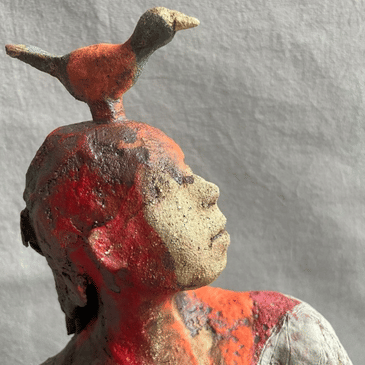
Have you ever wondered about using strong colours in slips on dark clay and how to make that happen? Then join us today as Bob talks with UK sculptor Su Jameson about her beautiful art, her journey in clay, and how she approaches colour and surface design.
You can find Su here:
Web: https://www.sujamesonart.co.uk/
Instagram: https://www.instagram.com/su.jameson/
[00:00:00] Time with contradiction. I grew up in the Caribbean and I've recently, and I've revisited the Caribbean where colour is a joy, where it's, it's sings from the houses and the shacks and the landscape, and it's not, no one's afraid of it. It's used to uplift and
[00:00:22] to make very simple, quite basic living standards, maybe much more vibrant and uplifting and joyous. The climate helps of course. Now, I also have this British side where pallets are much more muted and subtle and we look, you know, I'm looking at that when it's
[00:00:45] pretty grey, but there are some beautiful, beautiful soft greens and greys out there, which I also love. I'm Bob Acton and I'm pleased to share with you a conversation with Sue Jameson, a sculptor
[00:00:58] based in the UK. Her work on people and their stories is the focus of her explorations using hand-built ceramics. Both her expressionist, figurative forms and her surface decorations are just amazing. And she and I have a conversation about colour, surface design, form, and
[00:01:18] the need to listen to your heart. If you want to follow her, you'll see links to her website and Instagram accounts in the show notes. Sue, welcome to the Color and Ceramic Podcast to talk about colour and surface decoration.
[00:02:09] I'm very excited about you being here because I love your work and you make beautiful, sculptures and use brilliant colours and gorgeous surface design. And so welcome to the podcast. Well, thank you, Bob. What lovely introduction. I am an interesting woman. It comes to colour
[00:02:34] because I think colour is something I fight with in the rest of my life but in ceramics I really enjoy playing with it and having fun with it. I'm an awful interior designer.
[00:02:51] I'm an awful painter but when I come to making 3D pieces, I really enjoy the added colour at the end for me. Some ceramicists I know put the colour in to the clay, for example,
[00:03:08] they might put the colour in the process but I build something and then I have a huge amount of fun throwing colour at it. Nice, excellent. Could you maybe start off a little bit by telling us
[00:03:24] about your journey? Like a little bit about you and your work and what got you to hear in terms of your journey with clay? Okay, so I was born in Trinidad and I spent my formative years
[00:03:40] in a very colourful vibrant culture and I then came back to England for my later schooling life and I went to university and then after university I decided I needed to go to art school.
[00:03:58] I did a postgraduate sculpture which was when I learnt about the figure and modelling but I then worked mostly as a modeler and castor. I had some time in London when I was working
[00:04:16] in a cooperative studio and there was a big group of us so we would all work together making quite large scale, figurative pieces or stone carvings whatever it might have been and I then
[00:04:29] would cast in bronze at very occasionally but mostly in cement form due or plaster or resin but I had a team around me to help me with that and I then moved into teaching and started
[00:04:46] teaching in universities and then into schools when I had my own family and then when I decided that I wanted to return to my own practice I didn't have this big group of artists around me in
[00:04:57] a community studio. I just had my little shared at the bottom of the garden so I decided that ceramics might be an interesting new discipline to learn to keep me engaged and to turn me back into a
[00:05:12] learner having been a teacher for many, many years and also it was physically something I could manage on my own and it's proven to be both fascinating and challenging and frustrating in equal measure.
[00:05:27] I know you're a new, new ceramicist aren't you Bob and you'll you've been learning as well so although I was trained in clay I was never trained to keep the clay. The clay was a
[00:05:42] white product, it was a waste material so I've had to re-train my brain to really treasure the clay and treat it like a close relative really, nurtured and care for us and hope that it
[00:06:00] behaves itself in the farings and the drawing processes and so it's been a massive learning curve but I've really really enjoyed the challenge and yeah I still believe I have a huge amount
[00:06:13] to learn. I'm not a chemist either so I find the whole glazing chemical side of it quite daunting so I found a system that suits me which is mostly using one or two clay's colored slips
[00:06:34] and firing high to stoneware and then maybe occasionally glazing. It is complicated isn't it? I've had my hand in other crafty kinds of things particularly with wood and I have found clay to be far more complex with the chemical compositions that you're talking about the interactions with
[00:06:59] heat and temperature and surfaces like it's amazingly complex you have to have a lot of patience. You do and I feel you also have to have quite an ordered mind which I do not so I approached my ceramics more like a piece of fine art intuitive work
[00:07:24] it's not often highly planned. It's I'm not very good at record keeping so every piece is a one off I can't reproduce anything but I quite like that I don't like people have advised me in the
[00:07:44] profession to find a style and stick to it and get known for a certain type of work and that's never I think it happens anyway because you make what you make and you are a certain person but
[00:08:00] I find it difficult to repeat things. I would find that a bit boring to make the same thing over and over again is that true for you? Yes indeed yes and every time I think I'm going to do
[00:08:15] something it turns into something else but that's what I love about the creative process is that you never quite know where it's going to go and that's the thrill of it and if I knew
[00:08:27] if I was a little bit more scientific about it then maybe I could produce really exquisitely delicate finely formed pieces but that's just not the person I am so it wouldn't
[00:08:41] really be true to me I'm much more of a treat that clay in quite a raw way I keep it quite rough. I now at the moment using crank play because it's got a bit more grog in it and it allows me to be even
[00:09:00] more inventive with how I build my structures trying to break the structures up a bit just keeping myself on my toes never quite sure where I'm going. It is for me much more exciting than having a
[00:09:14] set plan. Yeah very cool and so when you're talking about sculptors needing to be a bit ordered did you mean that you think that you've been advised anyway that sculptors should have a specific plan
[00:09:29] in place and keep records and all the things that you are talking about? Not sculptor so much but ceramicists so the ceramic process the use of glazes the use of chemicals to make those glazes the
[00:09:43] use of oxides if you keep really meticulous records then you can almost repeat a favoured glaze or a favoured look or but I'll come across things will happen in the kiln and
[00:10:01] it'll be amazing and I love it or it'll be a disaster and I'll hate it which case I will rework something many times. So it's not a commercially viable way of working. I might fire something
[00:10:17] five or six times in order to get it speaking to me but I don't know when it's going to speak to me. I don't have a set idea of oh I'm going to do this then I'm going to do this then I'm
[00:10:31] going to it's much more intuitive and much more. I do something it speaks back to me I don't like it so I changed it it speaks back to me again so it's a dialogue quite a feisty dialogue at times
[00:10:46] and sometimes the pieces finished it's I don't like it it'll sit on the shelf for a couple of years and then I'll suddenly think I fall in and back in in light with it and I'll have another go
[00:10:59] which I know is against all the rules you know but I love that I don't I don't want to be rules particularly. Now you've said that before what is it about falling in love with a piece that
[00:11:14] you made two years ago against the rules? Oh the ceramic rules in that you're not supposed to refire things and add things on top and you know that there are purest well this is my
[00:11:28] certainly what I've read there are purest ceramic principles that one is encouraged to follow when learning however I know that the ancient masters and have always done things in different ways and that's how things evolve and change right that's how
[00:11:50] poor soul probably was invented was by somebody breaking a rule somewhere and finding a a different way to do something so I think it maybe comes from my quite traditional art school training when I wasn't just ceramicist at all I wasn't learning these things so ceramics is purely
[00:12:11] self taught but I did go to art school and I did learn to draw and I did learn to use clay to model the figure and I just enjoy not following some of the more specific things
[00:12:32] I was told having said that I'm now contradicting myself terribly because personally I love that's right so but every time I make clay it comes out figurative and I can't break that cycle
[00:12:48] it's interesting isn't it how will you make it useful well it's interesting I guess I've tried all sorts of different techniques and different things and what I'm finding I'm doing is now combining them
[00:13:00] and I think like you I'm finding what works it not so much about whether it follows a rule or not about whether it works in the studio and I think for the sculptural work that I'm more focused on these
[00:13:13] days and I use certainly are we don't have to worry about food safety and those kinds of things that the functional folks yes absolutely absolutely hey you said you've gone to school and
[00:13:27] you're you've now taken this intuitive approach to your to your sculptures and you said self taught on these things how did you learn about colors and surface design because that's really a key part of your work that I think came from being a teacher for many many years
[00:13:49] and just enjoying finding different ways to engage children mostly for me older children so I mostly taught young adults and teenagers how to engage them and just to enjoy color and texture
[00:14:08] and design and find a way to express something that we have the feeling or or what they think about something through this visual medium and as a teacher I would play a lot I think plays
[00:14:27] hugely important and so that fuel many of my processes in terms of whether I scruffy to something or whether I apply thick slips and then I pull it off it scraped it off again
[00:14:41] and that all very much comes from wasn't how I was taught tall but I think it was more how I taught in terms of keeping a piece of work alive by changing constantly changing it and and reworking
[00:14:57] and I think the the color principles are emotionally driven so I'll choose colors for a emotional reasons rather than all that goes with that so my color wheel is less formal than
[00:15:18] one you might see in an artwork it's much more what colors are speaking to me at that particular time in my life and that might be a result of a trip or something I see in nature
[00:15:30] or something I'm feeling on the inside. So I've to tell us a bit more about that that's like you've talked about your approach being quite intuitive and that story of colors sort
[00:15:42] of feels the same how does that play itself out in terms of you know what you might select when you're applying a slip to your piece why pink versus yellow as an example. Well it might be pink and yellow. Yeah I think I'm a contradiction.
[00:16:05] I grew up in the Caribbean and I've recently and I've revisited the Caribbean where colors are joy where it's it sings from the houses and the shacks and the landscape and it's not
[00:16:21] no one's afraid of it. It's used to uplift and to make very simple quite basic living standards maybe much more vibrant and an uplifting and joyous. The climate helps of course now I also have this
[00:16:40] British side where pallets are much more muted and subtle and we you know I'm looking at the window now and it's pretty gray but there are some beautiful beautiful soft greens and grays out there which I
[00:16:54] also love. So I think for many years that that pallet was dominant and then I'd for example went back to the Caribbean and these colors were just singing at me and I thought I've got to I've got
[00:17:08] to use those again and get re-engaged with my my younger self and what I used to love about that and then I just really enjoyed doing it. I really loved seeing these colors that you know really
[00:17:22] shouldn't be sitting next to each other having a lovely time doing so and also I think it's really important you'll know this well is that when you're using the slits they don't look like
[00:17:32] they're going to look when they're fired. So it's all a little bit of a mystery game and and you do it in the hopes that you're going to get the zing that you're after but until you've
[00:17:43] fired the piece you don't quite know and which is why when I said before I might fire a few times because the zing isn't quite there or that the well I mean I love I'm a lover of
[00:17:56] subtlety as well so that there might be a real nuanced shift from gray to green that isn't there and I just not shut the temperature a little bit and it'll start to come out
[00:18:10] or equally are my iPhone to high. So there's a lot there that I'm still discovering about color and the red as you probably know is a really difficult thing to achieve in the ceramic world
[00:18:25] so that is still a mission I don't use a lot of red because it is so hard to get it. It often comes out as a rust or as a brown but just that really bright red is very difficult certainly
[00:18:42] it's stoneware I think you can get them at low temperatures using over the miles but I don't do that and why I don't do that I'm not sure I just kind of ended up in the stoneware world
[00:18:56] and yeah I'm not sure why that came about I think it was due to the clays that I was using that needed to be fired pretty high and I've absolutely loved with this black clay that I use
[00:19:11] which does fire high. How are you? Well I'm firing it at about 1260 but it'll go up to 14. There's a real sense of when I look at your piece pieces that of this contrast, this kind of juxtaposition between the dark rough clay and the smooth bright colors.
[00:19:39] I mean personally I like that what is it that you're trying to achieve with that contrast in each piece? That's a good question. I don't want to overly hide the surface. I don't want to dress
[00:20:06] the sculpture too much because I love the raw clay in itself and I find it very expressive just on it so many, many times I've thought right leave this one don't paint, don't slip this one
[00:20:23] and I do have pieces that are darker than others but I just find that I guess it's a type of oh gosh I'm trying to find the right words why do I do it? What am I looking for in that contrast?
[00:20:42] I'm trying well or I can tell you as I'm trying to make work that have both something in the viewer. I'm not really making it to put on my own shelves and look at for the rest of time
[00:20:54] I have to get something out of me what that is changes each time I walk in the studio. I need to get something out of me, I find that I can get it out of me by making ceramic sculptures
[00:21:09] and I really hope that whatever I make has some impact on someone else one day somewhere in the world. I'm not particularly aware who my audience is. I just know that the way that I put my work out
[00:21:24] and it goes one day someone finds it and it works for them and that may take a day, that may take a year but so the use of the color against that deep black clay is I suppose that
[00:21:43] that juxtaposition I've talked about earlier between something very muted in my thinking and something really quite crazy and wacky and out there and I'm a bit of a contradictory person maybe and that comes out but I really don't want the work to look too disjointed or too chaotic.
[00:22:07] I need it to work as a whole and I'm not sure I'm there yet that's what I keep working at. My challenge is for the surface not to look like a surface but for it to look part of the piece.
[00:22:20] How it should be that it belongs there. You said you use slips and so I assume that you're using slips with stains in them to get the colors you're after. Do you ever play around with
[00:22:34] underglaces at all? I have. I find them a bit, I don't find the quality of the color quite as I would like so they very much are underglaces for me so they might sit four layers under something very rarely will they they find their way to the surface.
[00:23:02] I use a lot of oxides and that affects the slips in various ways quite exciting ways but now the colors slips are really like the way I can mix that almost like a palette
[00:23:20] and I sort of almost mix them as I put them on sometimes. I find it a very much freer process and the quality of the color is good for me anyway. I don't like shiny surfaces
[00:23:39] for some reason. I love that matte quality I almost want the color to look like it's coming out to the clay itself and maybe that's something I could investigate in the future and actually
[00:23:55] putting the pigment in the clay I've seen people do that. That would be a challenge with the clay that you're using because it's pretty dark, you'd get a very dark. You'd get a muted
[00:24:09] color at maybe in some ways right? I think the reason I like that dark clay is because it creates a depth to the underlying structure and so if you're using lighter clay I'll find that the light just
[00:24:26] bounces off the top whereas with this deep deep clay the light really the darkness is really dark and the shadows that it creates are intense. It really comes through the slip and the oxides
[00:24:44] as opposed to white clay which is the opposite. It doesn't come through at all and so you see more in the surface with the white. Yes I think that's sorry we're very round about where
[00:24:55] I think we've got that bulb with your help that I like the color that the clay to come through underneath the color and the color to be part of clay rather than having a piece of clay that
[00:25:08] is painted over the top of them. I want the two materials to work together as a fair part of each other. How do you think your choice of color influences the overall mood of the piece
[00:25:24] or the message that you want to get across to your buyers? I seem to go in waves and when I've made a collection and I tend to work in collections so I'll work on maybe 10, 12 pieces at a time.
[00:25:50] They will have not a totally replicated color scheme but they will have similarities of color coming through them and often if I've had a collection which is full of very clashing
[00:26:08] right vibrant colors. My next group of works can come from me and in a karma way so they may be more muted palette or a more restricted palette. The emotions are individual to each piece
[00:26:31] and I don't think the color alone does that. I think there is a lot in the expressions that I tried to create and those will change all the way through the making of the piece
[00:26:48] and so again a bit like when I was saying earlier about when something starts to speak to me it's to do with the colors but it's also very much to do with that expression
[00:26:59] and the colors may actually work with that emotion or they may fight against it but sometimes I like that fight because it's unexpected you see this bright pink and orange piece of work
[00:27:15] and you expect it to be one thing but as you get closer and you start to engage with the detail of it it turns into something very different and it kind of takes you on an emotional journey
[00:27:29] I don't want everything to be exactly what it looks like it's going to be. From the off but that is not intentional as I said it's just how it evolves in the making process
[00:27:42] because I change these things all the time. It's like you and the piece are having a dance together and in some way you put your left foot forward and they put their right foot back and you have to work
[00:27:56] together on that piece and I was going to ask you about balancing form with surface design because I remember when I was taking my first ceramics classes many many years ago that my first teacher talked about form and form was the answer for everything and that was primary
[00:28:17] and your forms are very unique figurative pieces that sort of in some ways make me think of soldiers I don't know why I think that when I see your latest pieces so how do you think about
[00:28:35] form along with the color or the surface? Okay that's a great question and it it provokes a little anxiety in me because I had a crit once not so long ago maybe two or three years ago from
[00:28:58] what would mean to be a highly regarded art academic who's crit was that the form and the form should dominate the form should be or everything and that the more and more you add to the surface
[00:29:17] the less the form can speak and the crit I guess was I needed to reduce what I was due to the surface in order for the form to come through and a little bit of me is still
[00:29:33] looking into that and thinking okay yes that's fair enough and I might sometimes get right to the end of a piece and just pour a huge amount of oxide over it in order to just limit some areas
[00:29:48] from that busy colored surface but however I think that the form is quite simple in most of my pieces and I'm not trying to make a highly intricate detailed sculpture and so therefore the surface
[00:30:16] textures and the things I scratch into it and the things I write into it can all be discovered on closer inspection. I hope that you kind of meet the piece several times you meet it from
[00:30:32] afar and then as you meet you meet it physically closer but also as you get to know it and you live with it you meet it closer still. However as a as a sculpture my original training was as a sculptor
[00:30:50] I would agree that the form needs to be the dominant aesthetic and I guess that's my challenge I'm still working on that and still learning about how much I want to let the joy and fun I have
[00:31:06] with the color and the surface and patterns and how much I want that to disappear in order for this form to come through and actually the pieces I'm working on at the moment the form is much more
[00:31:21] broken up so it is more complicated and it may be that as a result of that I have to let the the overall color and surface treatment of the piece be much more paired back because I think
[00:31:39] if I've got all of it going on then that might be too much but I will see I will try it out. I'll see you in the next video. I think so I mean I think I hear you saying that your pieces really
[00:31:53] big some inspection in some ways so you can see them the form from afar and of course the colors catch your eye but also people need to get up close and they need to see the little
[00:32:08] pieces that you put in there the little writings and in some ways I could feel like you want to come over and touch them because really they beg to be touched in lots of ways not there.
[00:32:19] Yes I love for work to be touched I would hate to have that preciousness one can often associate with a ceramic piece because it is it is a breakable material it's not like a bronze
[00:32:35] but I would love to be making work that people feel confident to touch and pick up and handle and in many ways the things I love about pieces of work that I look at and respond to
[00:32:54] from others but other people that they're keen is when I have to look again and again and again and each time I find a little extra something behind so the endless layering of colors and patterns and whatever it might be that is interestingly in that particular collection
[00:33:17] and it may be lost under as under a final coat of something but I know it's there and I hope that somehow the viewer will know it's there sorry but I've gone really dark
[00:33:29] it's okay sorry so I really hope that the even the things that can't be seen are still coming through in some way just not make any sense yeah no absolutely you know the underpainted yeah for sure there's like even some little secrets in there sometimes that
[00:33:52] you might put in that you to get covered up that you know or there but nobody else is there and it brings you a little pleasure seeing that piece and knowing that it's in that sculpture
[00:34:03] and somebody might catch it in a bit of a surprise or maybe not even quite understand the meaning of it in some ways yes and I think often when I work with galleries which I tend to do
[00:34:19] rather than selling directly because I'm not a very good sales person but the the gallery always wants to know quite a lot about the piece and obviously titles are very powerful things in how much you say how much you don't say I've always been very fascinated sometimes very
[00:34:44] frustrated when you walk up to this amazing piece of work and it's untitled and it's leaving all the work to you so I do love to give a little clue I influenced a lot
[00:34:57] by poetry and what like we've discussed in earlier the the heard word audio plays stories things that I might be listening to and so sometimes a title might be suggested but also I like
[00:35:13] the idea that the title might be in the piece itself because as pieces sculptor doesn't hang on a wall with a nice little notice next to it it has to stand on its own so often the
[00:35:23] title is in there somewhere it's written in there, scratched in there which I quite like even if it's un invisible by the end it's in there somewhere very cool you know you've got some great
[00:35:37] ideas here and I think our audience will be really fascinated with your approach to things and and I'm sitting here reflecting on the fact that you've been a teacher for many years
[00:35:49] and so have you got any advice for a budding ceramic artist or maybe a or maybe a sculptor who's changing their approach or like what advice would you have them about developing their own unique style make what you make don't worry about what everyone else is making
[00:36:16] try not to look too much out look in because you will never create uniqueness you will only stumble across it because if you try and do it you try and be unique you won't be but if it
[00:36:38] just comes from a very honest genuine place where you are just making what you make that will be unique because it is coming from yourself and you are an individual person
[00:36:52] I see so much out there that seems to be trying to emulate a particular wave or style or type of work whether that be to do with fashion or to do with popularity you're never
[00:37:14] you're never going to well this is just my thinking you're never going to grab find that catch that if you force it it has to just happen from your own personal motivation and direction
[00:37:29] and if people don't like it they don't like it it really doesn't matter if you if it's speaking to you and you feel you have something relevant to say then someone else out there
[00:37:42] one day somewhere will we'll get it and that as I said before that may take a day it may take a year it may take 10 years however this viewpoint doesn't necessarily give you a strong commercial basis for your work so I wouldn't say that I'm grateful that's true
[00:38:07] I do so my work I think is a great pleasure to find people who want to find a place for it in their world but the reason I make it is not that the reason I make it is because I have to make it
[00:38:22] or whatever reason that might be and if there are long spells where I don't make I feel really quite extraordinarily strange but I keep returning to making it so there must be something that is happening for me in the process and if someone else can share in that
[00:38:44] and get something from it then that gives me huge pleasure so my advice to anyone wanting to change or learn is to try not to be too afraid try not to worry about mistakes or getting things wrong
[00:38:58] and try not to make work that you see other people making because you'll only have a be a less version of them you have to be the best version of yourself there's an element I think
[00:39:12] it's certainly been true for me as I've learned to let go of worrying about whether somebody will like it or not or whether somebody will buy it or not has been a sense of introspection
[00:39:25] and to be able to be aware of those that little voice in me around what it is that I'm liking and to honor that I guess does that fit for what you're talking about? Absolutely you have to trust yourself you have to trust your own
[00:39:44] inner voice that you refer to then and critics will like it all over that that's but that's their perception if you're worried about critique you're in the wrong game I think it can be very helpful and harsh but you're always going to learn from it
[00:40:09] and that's just going to make your work stronger whether it be because you reject the critique or you think oh actually I could learn something from this so humanity is very important as well I think when you're learning a craft always feel like you have more to learn
[00:40:27] never feel like you've got there if you've got there then why making anymore? The whole reason we just keep making and making a making is because we're still trying to work without
[00:40:38] and so the day you feel you've worked all out probably when you need to move on to something else because it's that hunger and that desire for learning that keeps the work fresh and alive and
[00:40:52] relevant on a bad day well by will admit I think what am I doing? I'm just making more landfill for the world then I have to give myself a little bit of space and time
[00:41:06] and I then realize that oh I have got something I want to say I just happen to have chosen this form to say it in and that has relevance and I need to have confidence that I am entitled to say it
[00:41:29] whatever it may be and even if it's only for myself I still have that human gift of being able to communicate in so many different ways whether it be a written piece of work
[00:41:47] or a three-dimensional piece of work I don't know I just don't have another way I can say it so I do have to do this I didn't really feel this choice and really there are some people who
[00:42:05] will love your work and lots of people who will not and absolutely and it's about finding a way to connect with people who love it and listen to I was at a show recently and within minutes I had a
[00:42:22] couple of people walk by one young woman stood in the hallway at this big art show and pointed it one of my pieces and said oh that's nightmare food and I kind of laughed at that right but
[00:42:37] it was interesting because it produced an emotional reaction in her which I thought was really interesting and minutes later somebody else came by looked at the same piece and like oh I God I just love this
[00:42:50] so it's really interesting to see how people respond to our work and for us to not get but to listen to it but not get too wrapped up in it because then all we end up doing is trying to please
[00:43:02] somebody else yes that's no way to be I think the the contradiction or the the difficult thing I'm now going to say is that even though we're having a conversation about this very subject and
[00:43:26] that this is for other people's interest and I'd be delighted about the other people who interested quite understand if they're not but delighted if they are however my advice would be
[00:43:39] try not to look out I did say this before look out too much because I think the world we live in at the moment is so full of visual information what everybody else is doing whatever
[00:43:57] one else is making and although that can be just an amazing resource for nominal to find out what for example how would I ever know what you were doing all that way over on the other side of the
[00:44:09] world so that side of it is fabulous but don't let it make you feel overwhelmed by whatever one else is doing and that you need to do that too you just need to do what you do and I keep having
[00:44:23] to remind myself of this because as your experience shows people are going to walk past the love it and then another person's going to walk past and hate it and that's absolutely fine by me
[00:44:36] I just have to make what I have to make and if anyone else is interested then that's a bonus that's really great advice to really end our conversation on Sue I think I hope that people
[00:44:50] will have found our conversation to be interesting and learn some technical things like slips and oxides and so on that they might then begin to apply to their work if that interests them
[00:45:02] but really at the same time you really have to honor yourself in your own emotional space inside about what it is that you want to do so thanks so much for being with us here today Sue I really
[00:45:16] appreciate you spending your time here today I having this conversation well thank you so much for inviting me Bob it's been a pleasure to finally see you and have a chat with you
[00:45:28] keep working and I look forward to seeing all the new things you're going to make next year um thank you so much for having me you're most welcome thanks for listening to the color
[00:45:44] in ceramics podcast with Bob Act and and his guests please help others find the podcast by subscribing to this podcast wherever you find your podcasts such as iTunes Spotify Amazon Music YouTube or other podcasts and don't forget to give us a review we'll see you next time